REVIEW · BARCELONA
Private Barcelona Highlights: Gothic Quarter with a Local Guide
Book on Viator →Operated by Eternal Experiences · Bookable on Viator
Gothic streets can feel like a puzzle. This short, evening-paced walk through Barcelona’s Barri Gòtic shows you the layout fast, while a local guide ties the stonework to real Catalan characters and legends. I like that the route is tight, so you see the big names without spending your whole trip staring at street signs.
My favorite part is how the tour mixes major landmarks with small, story-filled stops—so you’re not just taking photos, you’re learning why these corners matter. One caution: guides can be very different, and there was at least one complaint about inappropriate language around children, so if that’s a concern, consider asking about guide tone before you go.
In This Review
- Key highlights and why they matter
- Stepping into the Gothic Quarter with a plan at 6:00 pm
- What the guide actually does for you (and why it’s worth it)
- Budgeting the admissions: what’s included vs not
- Stop by stop through the key Barcelona landmarks
- Els 4 Gats and the Kiss mural before the cathedral centerpiece
- Casa de l’Ardiaca and Pont del Bisbe: Roman waterlines and neo-Gothic myths
- Placa Sant Felip Neri and MUHBA El Call: war scars and Jewish memory
- Placa de Sant Jaume and Plaça del Rei: Catalan power and Inquisition shadows
- Plaça de l’Àngel and Santa Maria del Mar: grain trading, Saint Eulàlia, and the sea
- Who this tour suits best
- Practical tips before you go
- Should you book this Gothic Quarter highlights walk?
- FAQ
- How long is the Barcelona Gothic Quarter highlights tour?
- What time does the tour start?
- Where do we meet the guide?
- Where does the tour end?
- Is the tour offered in English?
- How many people are in the group?
- Are tickets included for Barcelona Cathedral and Santa Maria del Mar?
- What’s included in the tour price?
- Do I need to bring printed tickets?
- Can I cancel for free?
Key highlights and why they matter
- A 6:00 pm start keeps the Gothic Quarter atmospheric without a full day burn
- Up to 20 people means you’re not lost inside a huge herd
- Skip-the-stress routing across Barri Gòtic so you don’t waste time finding the next turn
- Two non-included admissions (Barcelona Cathedral and Santa Maria del Mar) help you budget upfront
- Legend-heavy stops connect Eulàlia, Roman Barcino, and even war scars to the streets you walk
Stepping into the Gothic Quarter with a plan at 6:00 pm

Barcelona’s old core is gorgeous, and also easy to get twisted up in. This tour is built for that reality. It’s about 2 hours, starts at 6:00 pm, and runs through Ciutat Vella with an ending near Santa Maria del Mar in El Born.
You meet at Plaça del Vuit de Març (08002), then finish at Basílica de Santa Maria del Mar, Plaça de Santa Maria 1 (08003). That end point matters: it puts you close to a lively area for dinner afterward, so you can roll right into your next meal without backtracking.
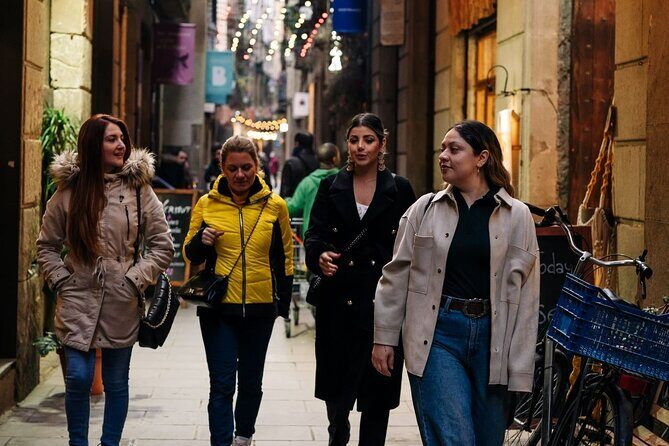
Also, this is not a tiny one-on-one experience. It’s a small group with a maximum of 20 travelers, so you’ll hear the guide, but you’ll still benefit from the social energy of meeting people from different places.
You can also read our reviews of more guided tours in Barcelona


What the guide actually does for you (and why it’s worth it)

A good guide is basically a shortcut. Not a literal shortcut through walls—more like saving your brain. The route covers classic “must-see” locations and also the stuff you’d usually walk right past, because you wouldn’t know it connects to a saint, a legend, or a citywide turning point.
From the feedback, guides like Darren, Craig, Mariah, Lydia, and Sara were singled out for storytelling that kept people engaged, plus solid site-by-site context. One big theme: you come away feeling oriented, like you understand where Barcelona’s old power and religious life sat in the map.
I also recommend paying attention to how your guide handles details. In the comments, there’s mention of hearing challenges at times, so if you’re someone who needs audio clarity, consider bringing your own way to listen if that’s feasible for you.
And here’s the practical part: if you care about specific expectations—like whether the tour will cover Sagrada Família content—clarify before you join. One person reported a mismatch around that topic, which is a good reminder that Barcelona tours can be “big city-wide” on paper, but “tight neighborhood focused” in reality.
Budgeting the admissions: what’s included vs not
The tour is priced at $180.22 per person, which is not cheap for 2 hours. Here’s the value logic that helps you decide if it’s right for you.
Most stops listed are free to view (like Els Quatre Gats, the kiss mural, Roman ruins in Casa de l’Ardiaca, and the squares). The cost you’re paying largely buys:
- a local guide
- a walking route that avoids aimless wandering
- interpretive stories that make the area make sense fast
Two stops have admissions not included:
- Catedral de Barcelona (Barcelona Cathedral)
- Basilica de Santa Maria del Mar
So you’ll want to budget a bit extra if you plan to go inside. If you mainly want exterior views and street-level atmosphere, you’ll still get plenty without feeling stuck paying for every door.
Stop by stop through the key Barcelona landmarks
Els 4 Gats and the Kiss mural before the cathedral centerpiece
You start with a spot that sounds like a quirky name, but it’s actually a cultural landmark: Els Quatre Gats. It sits in the famous Art Nouveau building Casa Martí, and it’s connected to the creative life of Barcelona—people tied to Pablo Picasso and Antoni Gaudí are associated with the place. Even if you’re not sitting down for a meal, this stop works as a tone-setter: the city’s Gothic streets aren’t isolated from modern art life; they overlap in time and imagination.
Next comes El Mon Neix En Cada Besada, the mural called The World Begins With a Kiss. What I like about this stop is that it pushes you from stone architecture into a message about freedom and the Catalan spirit. The guide’s job here is to connect what you see on a wall to the bigger cultural story it points toward.
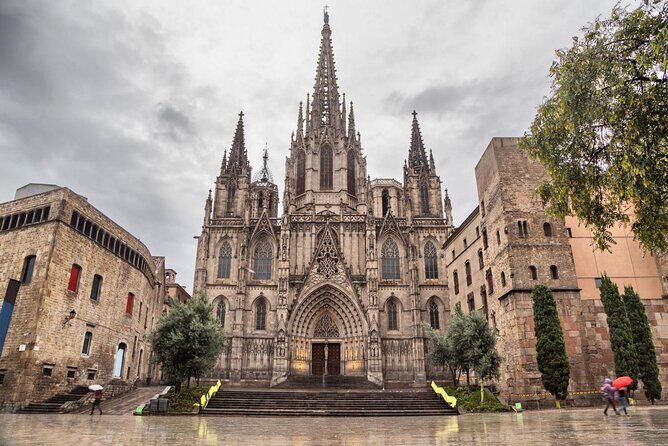
Then you hit the Catedral de Barcelona, the heartbeat of Barri Gòtic. The cathedral is more than a big building in your photos. The tour frames it around the patron saint Eulàlia, so as you look up and along the façade, you’re watching for the symbolism the guide points out—not just appreciating old style for its own sake.
One consideration: since cathedral admission isn’t included, decide early whether you’ll pay to enter or keep it to exterior time.
You can also read our reviews of more private tours in Barcelona



Casa de l’Ardiaca and Pont del Bisbe: Roman waterlines and neo-Gothic myths
After the cathedral area, the route shifts backward in time with Casa de l’Ardiaca. This is a compact site that punches above its size because it takes you to Roman Barcino and shows ruins tied to the city’s water system. The tour focuses on Roman wall traces and arcades linked to the aqueducts that supplied water—very “how did this city even work?” history, but delivered through things you can actually stand next to.
Then you cross to Pont del Bisbe—Bishop’s Bridge. It’s described as neo-Gothic, and the fun here is the legend component. Even if you’re not usually a legend person, I find that myth adds a layer to the architecture: it turns a bridge into a story marker in the street network.
If you like your Barcelona with a mix of stone + narrative, this is where the tour tends to feel most satisfying, because you can look around and mentally map what the guide is explaining.
Placa Sant Felip Neri and MUHBA El Call: war scars and Jewish memory
From architecture and mythology, the tour moves into the heavier side of city memory with Placa Sant Felip Neri. The square has the “scars” of the Spanish Civil War, which is the kind of context that makes you slow down and look differently at ordinary public spaces. You’re not just passing through; you’re seeing how conflict leaves marks on the built environment.
Then you go to MUHBA – El Call, the former Jewish quarter. The key draw here is that the neighborhood’s past isn’t abstract—it includes references to an ancient synagogue and the role El Call played in Barcelona’s story, plus legends that keep the memory alive.
This pair of stops works well if you want Barcelona to feel human, not just scenic. It’s also a smart contrast: religious life and neighborhood identity on one side, then the wartime shadow on the other.
Placa de Sant Jaume and Plaça del Rei: Catalan power and Inquisition shadows
At Placa de Sant Jaume, you’re at the political and civic heart of Catalonia’s story. The tour notes the seat of the Catalan government and City Hall, plus a connection to the story of a beloved saint. I like this stop because it turns Barcelona from “a city of churches” into a place where civic identity and faith both mattered in how people governed and celebrated.
Next is Placa Del Rei, King’s Square, with the Royal Palace nearby. The framing here is dark: the guide connects the space to the Spanish Inquisition era. That kind of context is useful because it changes how you think about the grandeur—less “wow, pretty palace,” more “how power worked here.”
If you’re the type who likes your sightseeing with clear cause-and-effect, these two squares do a lot of work in a short time.
Plaça de l’Àngel and Santa Maria del Mar: grain trading, Saint Eulàlia, and the sea
The route ends with a pair of stops that bring Barcelona’s identity back into focus.
First, Plaça de l’Àngel—Angel’s Square. The tour ties it to grain trading, and it also includes a story about a heavenly apparition and a procession linked to Saint Eulàlia. If you enjoy cultural legends, this one reads like a bridge between the sacred and the everyday: trade, religion, and public life all in the same small area.
Finally, you reach Basilica de Santa Maria del Mar in El Born. Admission isn’t included here either, so again: decide whether you want to pay to go in. The tour’s framing is maritime—this basilica is presented as a testament to Barcelona’s sea-based life. That matters because it balances the earlier religious and political focus. You get a sense that Barcelona’s old strength wasn’t only courts and cathedrals; it was also ships, commerce, and the ocean-facing rhythm that shaped the city.
Who this tour suits best
This is a strong fit if:
- it’s your first time in Barcelona and you want your bearings fast
- you like walking tours that turn streets into stories
- you want to cover the core of Barri Gòtic plus the transition toward El Born in a short window
- you’d rather pay for a guide than guess your way between sites
It may be less ideal if:
- you’re very sensitive to guide style and want guarantees about language tone (since there’s at least one mention of inappropriate language around children)
- you’re expecting a wider city jump—this is centered on the Gothic Quarter and nearby streets, not a full-day sweep
Practical tips before you go
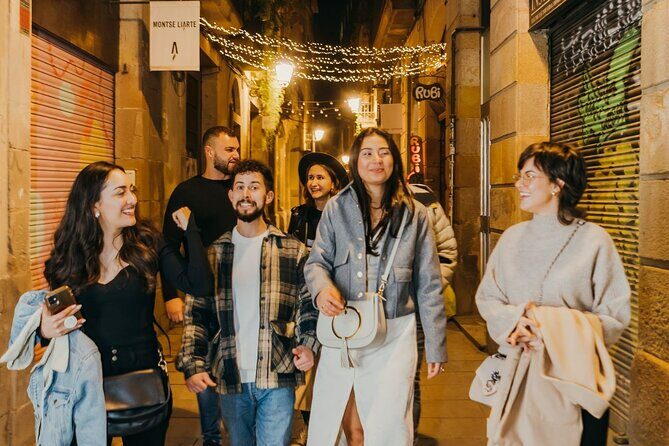
Wear shoes you can walk in for 2 hours on uneven old streets. Bring layers too—late afternoon weather can swing, and the Gothic Quarter can feel cooler once the sun drops.
Also, show up on time at Plaça del Vuit de Març. People praised how easy it was to find the guide in the start area, but the older streets reward punctuality. If you need specific inclusions (like particular monument coverage), ask clearly ahead of time so you’re not planning your expectations around a misunderstanding.
Should you book this Gothic Quarter highlights walk?
I’d book this tour if you want a focused, small-group evening orientation to Barcelona’s oldest neighborhoods, with stops tied to saints, Roman traces, and Catalan identity. The pricing feels steep at first, but it’s mostly paying for the guide’s ability to connect the dots while you walk.
I would not book it blindly if you’re traveling with kids and you expect a strict, always-calm guide tone. And I’d also confirm ahead of time whether your biggest “must-include” item—especially anything outside this Gothic core—is actually part of your experience.
If you match those two checks, this is a very solid way to start Barcelona: you leave with streets that make sense, not just images on your phone.
FAQ
How long is the Barcelona Gothic Quarter highlights tour?
It’s about 2 hours.
What time does the tour start?
The start time is 6:00 pm.
Where do we meet the guide?
You meet at Plaça del Vuit de Març, Ciutat Vella, 08002 Barcelona, Spain.
Where does the tour end?
It ends at Basílica de Santa Maria del Mar, Plaça de Santa Maria, 1, Ciutat Vella, 08003 Barcelona.
Is the tour offered in English?
Yes, it’s offered in English.
How many people are in the group?
The tour has a maximum of 20 travelers.
Are tickets included for Barcelona Cathedral and Santa Maria del Mar?
No. Catedral de Barcelona has admission not included, and Basilica de Santa Maria del Mar also has admission not included.
What’s included in the tour price?
Included are a guided walking tour, a local tour guide, city highlights, and off-the-radar stops (as part of what’s included).
Do I need to bring printed tickets?
No, you receive a mobile ticket.
Can I cancel for free?
Yes. You can cancel for a full refund if you cancel at least 24 hours before the start time.