REVIEW · BARCELONA
Barcelona Premium: Gothic, Montjuic, Sagrada Familia & Park Güell
Book on Viator →Operated by We Are Guides Barcelona · Bookable on Viator
Barcelona in one packed day. This small-group route strings together Gaudí and the medieval lanes of the Gothic Quarter, then finishes at Sagrada Família. You get guided stops, private rides between areas, and photo-ready viewpoints along the way.
I like the pacing: you start with an in-town walking loop through Roman and medieval sights, then you switch to comfortable transport for Montjuïc. I also like that the tour handles the big timed entries, so you’re paying for a plan that protects your time more than most DIY days.
The main consideration is walking. Between the Gothic streets, the public areas at Park Güell, and the final walk at Sagrada Família, you’ll want solid footwear and a steady pace.
In This Review
- Key highlights worth your attention
- Why This Barcelona Premium Tour Works So Well in a Limited Time Window
- Gothic Quarter from Plaza Catalunya to Santa Maria del Mar: Where the City Starts to Make Sense
- A realistic note on this walking segment
- Catedral de Barcelona and Sant Jaume Square: The Two Faces of Old Barcelona
- Santa Maria del Mar Coffee Break: A Pause That Helps You Actually Enjoy the Day
- Montjuïc by Comfortable Transport: The Face of Barcelona to Miramar Views
- Why Montjuïc is worth the ride
- Park Güell Public Areas: What You See, What You Skip, and How to Make It Count
- A small caution about timing and stamina
- Sagrada Família: Facades, Symbolism, and the Guaranteed Ticket Moment
- What to do during the visit
- Price and Tickets: Where the Value Really Comes From
- Transportation matters more than you think
- Tips for Getting the Most Out of This Day (Without Making It Harder)
- Who This Tour Fits Best (and Who Might Want a Different Plan)
- Should You Book This Barcelona Premium Tour?
- FAQ
- What’s included in the guided sightseeing portion of this tour?
- Are Park Güell tickets included in the tour price?
- Are Sagrada Família tickets included in the tour price?
- Is transportation between neighborhoods included?
- How long is the tour, and how much walking should I expect?
- Where does the tour start and end?
- What happens if the weather is poor or the tour must be canceled?
Key highlights worth your attention
- Small group energy: up to 22 people, so your guide can actually answer questions
- Gothic Quarter with real specifics: Cathedral area, Jewish Quarter, St. James Square, and Santa Maria del Mar
- Montjuïc viewpoints in one shot: Miramar Viewpoint plus big-city views from the hill
- Major Gaudí stops with tickets handled: you pay for Park Güell and Sagrada Familia on the day
- Photo stops from the vehicle: Face of Barcelona, Columbus Monument, and Casa Batlló sightlines
- Guide-led meaning, not just looking: symbolism and facade details at the Gaudí sites
Why This Barcelona Premium Tour Works So Well in a Limited Time Window
If you’re trying to squeeze Barcelona into one main day, this tour has a smart structure. You begin where the city’s story layers up fast (Roman-era edges, medieval lanes, civic squares), then you climb into Gaudí-and-views territory, and you end on the biggest wow-factor of all at Sagrada Família.
What makes it practical is the mix of walking and rides. The morning is mostly footwork through compact areas that are hard to navigate alone without losing time. Then the tour uses private, comfortable transport to hop between neighborhoods and viewpoints, including Montjuïc, where distances are not friendly on foot.
I also like that your guide’s job isn’t only to get you from A to B. Guides listed for past groups, like Xavi, Montse, Faidra, Phaedra, Miguel, and Nuria, are known for storytelling that connects details you’d otherwise miss—especially when you reach Gaudí.
You can also read our reviews of more tours and experiences in Barcelona.
Gothic Quarter from Plaza Catalunya to Santa Maria del Mar: Where the City Starts to Make Sense
You start at Pl. de Catalunya near Olívia Plaza Hotel, then the tour pulls you into the old-city center. The first stop is the Gothic Quarter, a maze of narrow streets with Roman and medieval architecture all tangled together in a way that feels instantly Barcelona.
This isn’t just wandering. You’re guided past key landmarks and through the areas that define the neighborhood’s personality:
- You get time around the Cathedral area (even if entry isn’t included, the exterior details are part of the point).
- You pass through the Jewish Quarter region.
- You visit St. James Square (Placa de Sant Jaume later, too, for the civic side).
- You also get a look at part of the Roman wall—a reminder that this city has been here for a very long time.
The best part of this section is how it turns the Gothic Quarter into a readable map. When your guide points out why the streets feel the way they do, you start understanding the layout instead of just collecting photos.
You’ll also end the walking tour at Santa Maria del Mar in the Born district. It’s one of those places where Barcelona’s history feels human scale: you can’t help but slow down, even if your day is moving.
A realistic note on this walking segment
The upside is that the old center is compact enough to pack into a morning. The drawback is that the lanes are narrow and you’ll be walking for real, not strolling. If mobility is limited, this is the part to think about first.
Catedral de Barcelona and Sant Jaume Square: The Two Faces of Old Barcelona
After the initial Gothic Quarter walk, the tour sharpens the focus with short, targeted exterior explanations.
First is a dedicated stop for the Catedral de Barcelona, where the guide talks through exterior facades. This kind of stop matters because Barcelona’s architecture is often best understood by details: how elements relate, what the building is trying to communicate, and how the design fits its time.
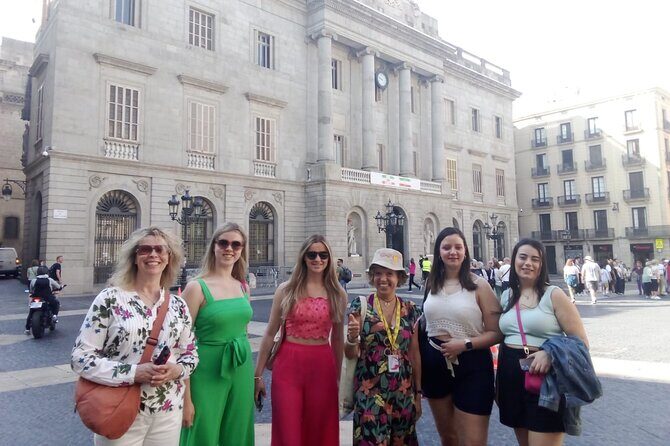
Then you cross into Placa de Sant Jaume (Saint James Square). This is the civic counterweight to the church-centered vibe. Here you see where Barcelona’s government presence lives, including the City Hall area and the Palau de la Generalitat. It’s a good reminder that the city isn’t only sacred buildings and old stones—it’s also power, administration, and public life.
If you’ve only seen Barcelona as postcards, this pair of stops gives it grounding. It connects “pretty architecture” to “this is how the city worked.”
Santa Maria del Mar Coffee Break: A Pause That Helps You Actually Enjoy the Day
You get a coffee break at Santa Maria del Mar, giving you about a half hour. I like this kind of scheduled pause, because by mid-morning your brain has absorbed a lot of stone and street texture.
Use the time in the simplest way possible:
- Sit and look back at the facade and surroundings.
- Take a few photos from an angle that doesn’t force you to wait for the crowd.
This is also a good moment to reset if you’re heading into Montjuïc later. Your feet will thank you, and you’ll be ready for the steep, scenic shift that comes next.




Montjuïc by Comfortable Transport: The Face of Barcelona to Miramar Views
After the Born-area walk, you switch gears with private transport up to Montjuïc. This is where the tour turns scenic and cinematic, and you get the “Barcelona from above” experience without needing to plan buses or a taxi route.
On the vehicle, you get built-in photo stops and signature skyline sights:
- The Face of Barcelona at the port area: a giant human profile formed from letters and symbols, meant to catch your attention immediately.
- The Columbus Monument: a tall 60-meter column with Columbus at the top pointing out toward the sea.
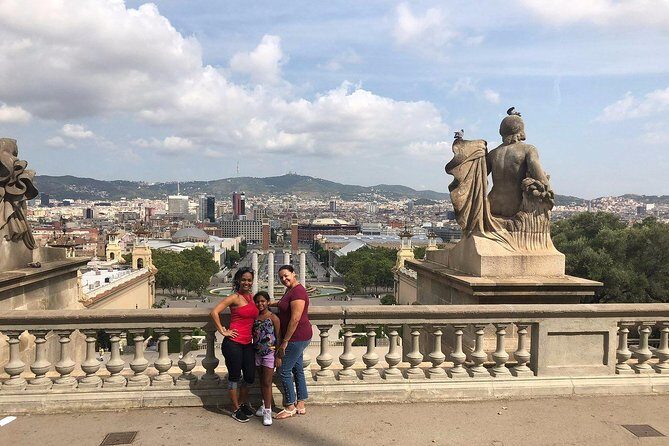
Then you climb toward one of Montjuïc’s best viewpoints: Mirador de Miramar. You’ll pause there to appreciate the city skyline and snap photos with hills as a backdrop. This viewpoint stop is short, but it’s timed so you’re not stuck guessing where to stand.
From the vehicle you also get views tied to major cultural sites:
- The Fundació Joan Miró (Miró Foundation) shows from the hillside, including the striking architecture perched above the city.
- The Olympic Stadium and its Olympic legacy come next, with a note that on certain days the stadium may be open to the public and you could even catch a glimpse of the interior. The nearby Olympic Museum is highlighted as well, though this tour won’t promise you entry—just the context and the sights.
Finally, you pass MNAC (Museu Nacional d’Art de Catalunya), another Montjuïc anchor building. It’s mostly a pass-by viewing moment, but it gives you the “I’m on the hill with Barcelona’s big institutions” feeling.
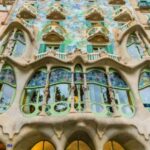
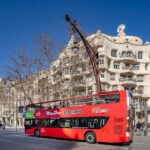
And just to keep the city texture coming, you get a pass by Casa Batlló on Passeig de Gràcia. You won’t stop, but you’ll still see why it’s one of Gaudí’s most iconic modernist facades.
Why Montjuïc is worth the ride
Montjuïc is the kind of place where you can easily spend an entire day if you DIY it—getting there, getting up, figuring out viewpoints. This tour compresses it into a manageable timeline while still giving you the major outlooks and symbols.
The trade-off is that you’re not going deep into museums during this segment. If you want to spend hours inside MNAC or the Olympic Museum, you’ll need to pair this day trip with separate visits.
Park Güell Public Areas: What You See, What You Skip, and How to Make It Count
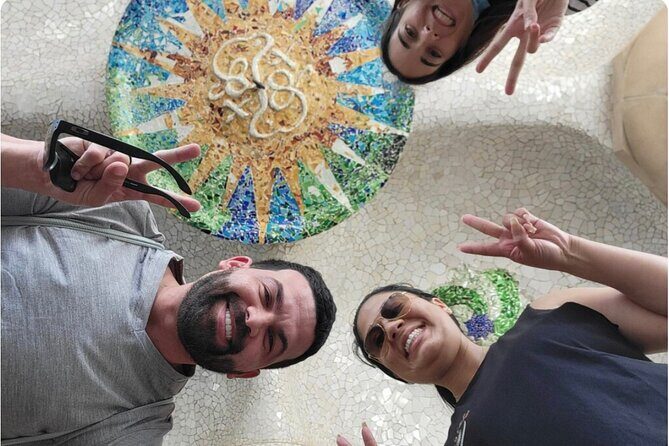
Park Güell is on Tibidabo mountain, and the tour includes time for a walking look through the public area. A key point: the tour price does not include the Park Güell ticket.
You’ll pay €18 per person on the day, and the guide handles getting your entrance arranged after the walking portion (so you don’t need to wrestle with external ticket purchasing). The tour’s description is clear: entrance is arranged; you just handle the payment portion.
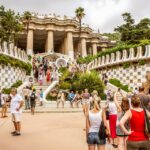
What you should plan for here is a walking experience that’s more “park stroll” than “museum tour.” You’re there for gardens and the feeling of Gaudí’s imagination stretching into outdoor space. The public-area route also makes sense if you’re curious but don’t want to lose the whole day chasing timed entry everywhere.
A small caution about timing and stamina
Park Güell is not far from “steep sidewalks and uneven surfaces” territory. Even if you’re not doing the most intensive parts, comfortable shoes matter. If you’re already tired from the Gothic Quarter morning, this is where your pace matters.
Sagrada Família: Facades, Symbolism, and the Guaranteed Ticket Moment
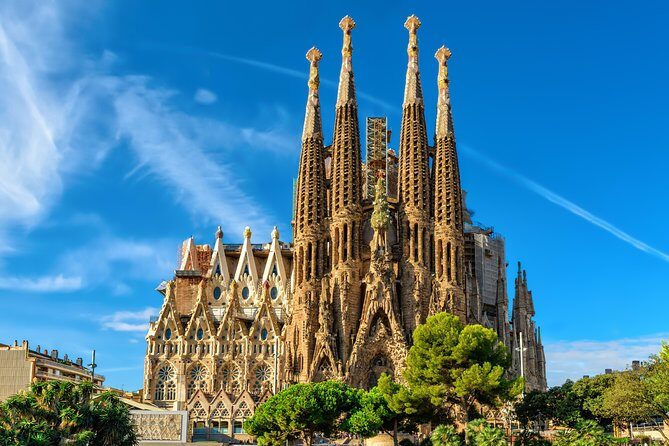
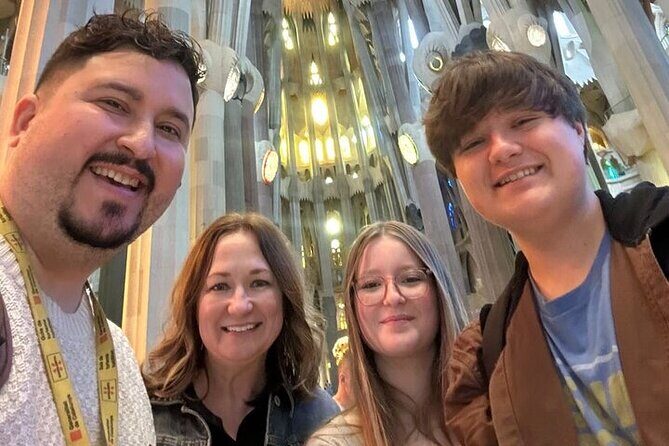
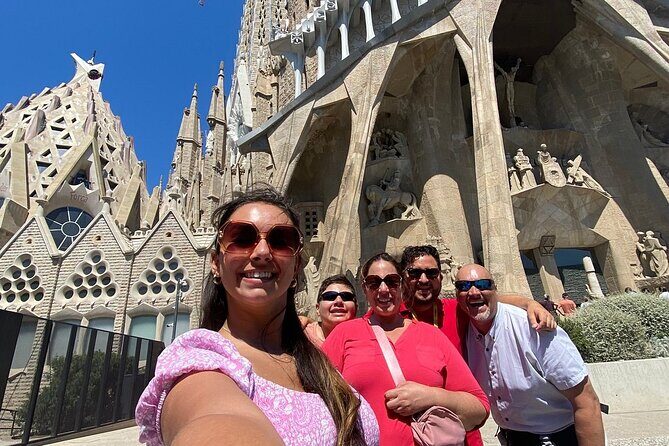
The day’s final big act is Sagrada Família. You’ll learn about the basilica’s history and its “mystical symbolism,” with a guide-led explanation focused on facades. Then you’ll tour the outside views and also see the interior, which is the part people remember afterward.
The ticket isn’t included in the base tour price, but you’re covered in a practical way. The tour lists €26 per person for Sagrada Família, and you’ll pay the guide on the day. The important line for your planning is that your entrance is guaranteed.
In plain terms, this is what you want for Sagrada Família: a guided explanation that slows you down just enough to notice details. The building is so visually loud that without commentary, you might enjoy it but miss why the architecture feels the way it does.
What to do during the visit
Your best strategy is to alternate between:
- staring at the big picture (the overall interior and facade vibe)
- then moving to details your guide points out
If you do that, the visit sticks. You won’t just remember that it’s impressive; you’ll remember what made it impressive.
Price and Tickets: Where the Value Really Comes From
The headline price is $129.71 per person for about 6 hours. In practice, plan for a longer day because you’re combining walking, transport, and two major sites.
Here’s how the money breaks down:
- The tour itself covers the guide, private transport, photo/viewpoint stops, and the core guided walking parts.
- You add monument tickets on the day for the two main paid sites: €18 for Park Güell and €26 for Sagrada Família.
- That totals €44 per person you pay to the guide for the tickets.
Is that good value? For many first-time visitors, yes—because two things are hard to DIY smoothly in Barcelona:
1) timing timed-entry demand for the big Gaudí sites
2) doing neighborhood-to-neighborhood transitions without losing half a day to transit planning
Also, the small group size (maximum 22) is part of what you’re paying for. A larger group can make a “detail-heavy” tour feel rushed. A smaller group makes it easier to hear explanations and keep your place in the route.
Transportation matters more than you think
Private, comfortable transport between neighborhoods can change how the day feels. Instead of fighting steep climbs and long cross-town gaps, you keep your energy for the parts that are actually walk-based.
Tips for Getting the Most Out of This Day (Without Making It Harder)
Based on how the tour runs, I’d plan around comfort and attention.
- Bring comfortable shoes. This isn’t a sit-behind-the-guide type of day.
- Expect narrow streets in the Gothic Quarter. That’s part of the magic, but it’s also why the walking can feel more intense than you’d guess from a map.
- Keep your eyes up during vehicle rides. Stops at the Face of Barcelona and Columbus Monument are quick, but they’re designed for photos and skyline context.
- Save your phone batteries. You’ll get viewpoints like Miramar, plus the big Gaudí scenes at Park Güell and Sagrada Família.
If you care a lot about explanations, position yourself closer to the guide during the main walking segments. The tour notes a group setup, and in crowded places, being slightly forward helps you catch more of what’s being said.
Who This Tour Fits Best (and Who Might Want a Different Plan)
This tour is a strong fit if you:
- want a first-timer overview that connects Barcelona’s old center to Gaudí’s masterpieces
- like structure and guided context more than wandering on your own
- value pre-arranged tickets for high-demand sites
- appreciate a mix of viewpoints and walking, without spending time planning transport
It may not be ideal if you:
- hate walking and want mostly seated sightseeing
- want lots of free time at one site instead of moving through multiple highlights
- prefer museum-style time inside lots of venues (this tour’s Montjuïc portion is more about sights than long museum sessions)
Should You Book This Barcelona Premium Tour?
If you’re on a tight schedule and you want the biggest Barcelona “anchor moments” in one day, I think this is a smart booking. You get Gothic Quarter context, Montjuïc viewpoints, and the two major Gaudí visits with tickets handled through the guide—so your day stays focused instead of turning into a logistics scramble.
Book it if your priority is a guided storyline from medieval Barcelona to Gaudí’s world. Skip it or adjust expectations if you want a lighter walking day, deep museum time on Montjuïc, or only one Gaudí stop.
FAQ
What’s included in the guided sightseeing portion of this tour?
You’ll get an expert local guide, private comfortable transport between stops, and guided walking time in the Gothic Quarter (including the Cathedral area, Jewish Quarter region, St. James Square, and Santa Maria del Mar exterior). You’ll also have guided visits tied to Montjuïc viewpoints and photo stops from the vehicle.
Are Park Güell tickets included in the tour price?
No. Park Güell’s ticket price is not included. You’ll pay €18 per person on the day after the walking portion, and the guide will handle getting the tickets so you don’t have to purchase externally.
Are Sagrada Família tickets included in the tour price?
No. Sagrada Família’s ticket price is not included. You’ll pay €26 per person on the day, and your entrance is guaranteed with the pre-arranged tickets.
Is transportation between neighborhoods included?
Yes. The tour includes private, comfortable transportation between the main areas so you can move between the Gothic Quarter, Montjuïc, Park Güell, and Sagrada Família.
How long is the tour, and how much walking should I expect?
The tour is listed at about 6 hours. The day includes a walking tour in the Gothic Quarter, additional walking at Park Güell’s public area, and walking around Sagrada Família, so comfortable shoes are important.
Where does the tour start and end?
The tour starts at Olívia Plaza Hotel, Pl. de Catalunya, 19, Ciutat Vella, 08002 Barcelona. It normally ends at Sagrada Família, but the end point could shift to Parc Güell depending on operational circumstances.
What happens if the weather is poor or the tour must be canceled?
The experience requires good weather. If it’s canceled due to poor weather, you’ll be offered a different date or a full refund. It also depends on meeting a minimum number of travelers; if that minimum isn’t met, you’ll get an alternative date/experience or a full refund.