REVIEW · BARCELONA
Enchanting Gothic Quarter by Night Tour
Book on Viator →Operated by Green Tours Barcelona · Bookable on Viator
Barcelona feels different after dark.
This 6pm nighttime walking tour takes you through Barcelona’s Gothic Quarter when streets are calmer and the sun isn’t baking everything. You’ll move from big names like Barcelona Cathedral to lesser-seen corners tied to legend, religion, and daily Catalan life. It’s priced low for what you get: a guide, a clear route, and built-in photo help to make the sights stick.
I especially like the way the tour connects the dots between eras, from Roman Barcino and necropolis sites to medieval power centers. Two stops that stand out for me are the Plaça de la Vila de Madrid (with its Roman necropolis setting) and the Esculptura de lletres Barcino, where you can literally see an ancient entrance theme. One thing to keep in mind: this is a walking tour with short stops, so you’ll mostly view sights from the outside rather than settling in for long interior time.
In This Review
- Key points you’ll care about
- How the 6pm start changes the Gothic Quarter experience
- The meeting point: Hard Rock Café to launch your bearings
- Las Ramblas at night: fountain fun and an easy warm-up
- Roman Barcelona roots at Plaça de la Vila de Madrid
- Santa Maria del Pi: understanding Gothic architecture from the outside
- Barcino lettering sculpture: a small stop with big meaning
- Barcelona Cathedral: where Gothic styles meet and religion gets explained
- Placa del Rei: the political past, right next to the old royal stage
- Caganer: Barcelona’s humor, not just a souvenir
- Placa de Sant Jaume: where the city’s government story lives
- End at Placa Sant Miquel: human tower culture and food ideas
- Price and value: what $21.69 gets you (and what it doesn’t)
- Guides set the tone: why Tyler and Paulo stand out
- Practical tips before you go
- Should you book the Enchanting Gothic Quarter by Night tour?
- FAQ
- What is the duration of the Enchanting Gothic Quarter by Night Tour?
- Where does the tour start?
- Where does the tour end?
- What time does the tour start?
- How much does the tour cost?
- Is the tour ticket digital or paper?
- Is food included in the tour?
- What’s included with the tour price?
- Is the tour mostly inside places or outside viewing?
- Is the tour limited to a small group?
- Are service animals allowed?
Key points you’ll care about
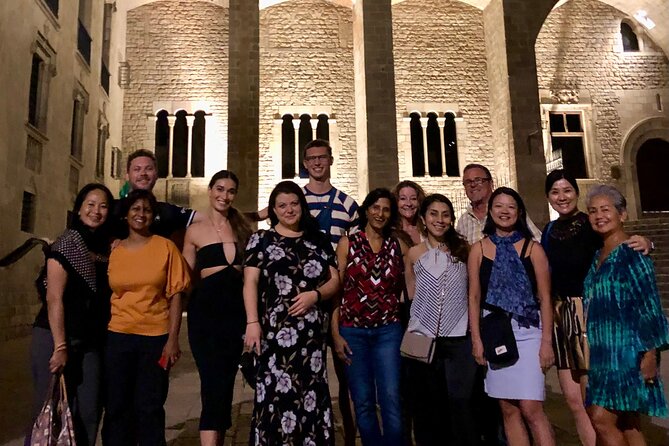
- Night-first route: you’re seeing the Gothic Quarter in cooler, less crowded light
- Roman to medieval storytelling: Plaça de la Vila de Madrid and Barcino lettering bring early Barcelona into focus
- Real local culture stops: Caganer shows up as a playful Barcelona tradition
- Politics included, in context: Plaça de Sant Jaume is used as the setting for today’s city power talk
- Short, efficient timing: 2 hours total with quick visits that keep the walk moving
- Photo support from your guide: photos and images help you understand what you’re looking at
How the 6pm start changes the Gothic Quarter experience
A daytime Gothic Quarter visit can feel like you’re fighting the clock and the crowd. The value of this tour is timing. Starting at 6:00 pm means you’re catching the neighborhood as it switches from tourist crush to evening life. The walk is also only about 2 hours, so you get a full story arc without losing an entire evening.
Because the group is capped at 20 travelers, it’s easier to hear your guide at street level. And because it’s designed as a moving route—with multiple short stops—you’re not stuck in one place when the crowd pressure builds.
One practical plus: you don’t have to worry about paper tickets. The tour uses a mobile ticket, and the confirmation comes at booking. That reduces the hassle before you even arrive.
You can also read our reviews of more tours and experiences in Barcelona.
The meeting point: Hard Rock Café to launch your bearings
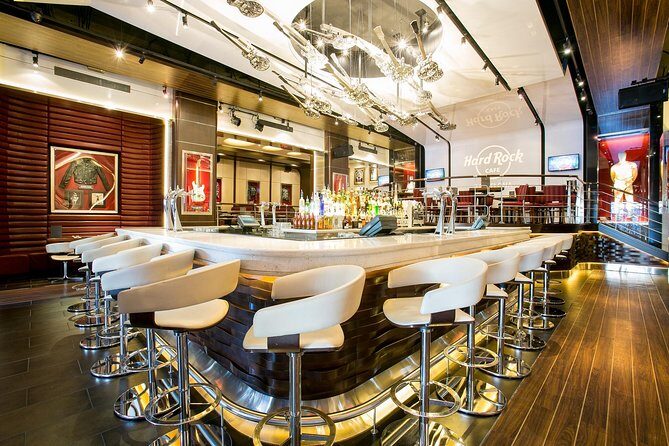
You start at Hard Rock Cafe Barcelona on Pl. de Catalunya, 21, in Ciutat Vella. You meet outside the cafe in front of Plaza Cataluña, which is a smart choice: it’s central, easy to reach, and you’re not wandering around trying to find a random side street.
The first stop is basically a launchpad. Your guide welcomes the group and sets expectations so the walk feels like a guided story instead of just a list of monuments. Expect around 15 minutes here, with admission listed as free.
This matters more than it sounds. The Gothic Quarter can look like a maze, and without a narrative, you’ll see stone and arches but miss the why. The preface helps you understand what to watch for as you move deeper into the neighborhood.
Las Ramblas at night: fountain fun and an easy warm-up
From Plaza Cataluña, you head toward Las Ramblas for about 10 minutes. The tour route includes a playful moment: you’ll go along the promenade while drinking the water from a fountain (the tour calls it magical water).
It’s not about the fountain water itself. It’s a warm-up that gets you out of “big street” mode and into “Barcelona legend” mode. You’re also transitioning from the wide avenue vibe into tighter lanes and squares where the Gothic Quarter’s character shows up.
If you’re arriving from another part of the city, this segment is an easy buffer. You get motion, you get context, and by the time you reach the quieter squares, your brain is in the right gear.
Roman Barcelona roots at Plaça de la Vila de Madrid
Stop 3 is Plaça de la Vila de Madrid, where the setting helps you understand the scale of what you’re about to see. The square is surrounded by pines and jacaranda trees, and it’s tied to a Roman necropolis from the first century AD.
This is one of the best value moments on the route because it flips your expectations. The Gothic Quarter often gets treated like only medieval stone. But Barcelona started earlier, and Roman layers still shape the city. Standing here with your guide’s explanation lets you connect the neighborhood you see today with the city that came before it.
Time is about 15 minutes. That’s enough to get the key ideas without stalling the group. You’ll likely leave this stop understanding why archaeologic sites like necropolises are more than odd detours—they’re evidence of how people lived, died, and organized space.
Santa Maria del Pi: understanding Gothic architecture from the outside
Next is Basilica de Santa Maria del Pi, a Gothic basilica from the 14th century. Important detail: on this tour you only visit the outside area. Expect about 15 minutes devoted to what you can see and how your guide explains the Gothic architecture style.
This stop works best if you like architecture that feels functional. You’re not just admiring decoration—you’re learning how design creates a mood and signals power and faith.
If you were hoping for long interior time in major churches, adjust your expectations. This tour is built for motion and story, not for deep museum-style stops.
Still, the exterior is an advantage at night. Lighting makes stone look dramatic, and your guide can point out features you might otherwise miss—especially in a quick photo-friendly way.




Barcino lettering sculpture: a small stop with big meaning
Stop 5 is Esculptura de lletres Barcino. This is an “ancient entrance” theme connected to the Roman villa Barcino, dating to the 1st century BC.
It’s short—about 10 minutes—but it’s memorable because it’s physical. You’re not just hearing about Rome in abstract terms. The sculpture concept ties the modern street into ancient geography, so the story feels less like trivia and more like a map.
When a tour includes a stop like this, it changes how you walk the rest of the Gothic Quarter. You start noticing layers: where medieval shapes sit on older footprints, where the city preserved clues even as it rebuilt.
Barcelona Cathedral: where Gothic styles meet and religion gets explained
Stop 6 is Barcelona Cathedral (Santa Cruz and Santa Eulalia). You get about 15 minutes here. The tour description highlights how medieval Gothic and Neo Catalan Gothic meet, creating a view that’s interesting both architecturally and culturally.
Your guide uses this moment to talk about religion, architecture, and local culture. That blend is the point. Barcelona’s religious buildings aren’t only religious buildings. They’re visual statements about identity and history, and the Gothic Quarter is where that identity becomes obvious.
Cathedral stops can go two ways on walking tours: either you’re rushed and left staring at stone, or you get enough framing to understand why the building looks the way it does. With this route’s structure—multiple stops, each with a reason—you’re more likely to get the second.
If you care about the “why” behind architectural choices, this is one of the stops you’ll value most.
Placa del Rei: the political past, right next to the old royal stage
Stop 7 is Placa del Rei, about 15 minutes. This plaza, along with the Royal Palace and the Chapel of Santa Agatha, is used to show “vestiges” of kingdoms that still feel anchored in the Gothic Quarter.
What I like about this stop is the pacing. You’ve already moved through Roman and Gothic architectural thinking. Now you get a power-focused lens: who held control here, how the city centered itself, and how royal and religious spaces overlapped.
It’s also a good visual moment. Plazas give you breathing room, and at night they feel calmer than the major streets. If you want a quick, clean set of photos without fighting for a spot, this is often the kind of area where it’s easier.
Caganer: Barcelona’s humor, not just a souvenir
Stop 8 is Caganer, a brief 10-minute stop that’s easy to miss if you don’t expect it. The tour frames it as a playful element of Barcelona’s jocular culture, and yes, it’s the figure connected to the tradition of the pooper.
This is a small stop, but it’s a smart inclusion. The Gothic Quarter isn’t only cathedrals and kings. It’s also everyday Catalan humor that survived as tradition. Learning this piece of cultural context helps the rest of the tour feel less like a textbook and more like a city you can actually understand.
If you’re traveling with kids, this kind of moment tends to be memorable for the right reasons. Even in short form, it adds a human angle.
Placa de Sant Jaume: where the city’s government story lives
Stop 9 is Placa de Sant Jaume, about 10 minutes. This is the government plaza, and the tour includes commentary on the current political situation of the city.
You won’t get politics in a vacuum here. You’re in a place that visually signals civic authority. That makes the talk more grounded, because you’re not just hearing slogans—you’re standing in the kind of square where decisions feel close to the street.
This stop is also where the tour’s “many visitors miss” promise becomes real. If your mental picture of Barcelona is only beaches and street art, this is a reminder that the Gothic Quarter is part of Barcelona’s modern identity too.
End at Placa Sant Miquel: human tower culture and food ideas
The final stop, Placa Sant Miquel, takes about 5 minutes. This square includes the monument of the traditional Human Tower of Catalonia. It’s a short ending, but it lands the cultural message: Catalonia’s identity shows up in both historic power and living traditions.
The walk ends here, with the tour also providing a list of local restaurant recommendations. Those suggestions are useful because it gives you a fast next step after the tour—especially if you don’t want to guess where to eat at night.
The tour’s end location is near Plaça de Sant Jaume, which is handy for getting around. The guide even builds the route so you finish in a central area rather than a remote pocket.
Price and value: what $21.69 gets you (and what it doesn’t)
At about $21.69 per person for a roughly 2-hour nighttime guided walk, this tour is priced for accessibility. You’re not paying for museum admissions, and you shouldn’t expect that. Most listed entries show free admission, and the key learning is done through your tour guide, plus photos and images to help the sights make sense.
The main value is the combination of:
- time-saving structure in a complex neighborhood
- context, from Roman sites to medieval power spaces and modern politics
- a small group cap (up to 20), which helps explanations stay clear
What you don’t get is long indoor time at major sites. Also, any food at the end is optional and on your own expense: you can choose churros with hot chocolate or gelato/ice cream.
If your goal is a quick, focused way to understand the Gothic Quarter without roasting in midday heat, the price feels fair. If your goal is slow wandering with deep interior visits, you may want a different style of tour.
Guides set the tone: why Tyler and Paulo stand out
The guides matter a lot on walking tours, and here the information feels designed to be understandable. In particular, guide names Tyler and Paulo have come up alongside comments about how informative and engaging the tour felt. In one case, the walk worked well even with kids, which tells me the explanations can land across ages.
So if you prefer a guide who explains clearly rather than assuming you already know the city, this format is a good match.
Just remember: this is a 2-hour street route, so the guide’s best work is at street level—pointing, timing, and connecting each stop to the next.
Practical tips before you go
This tour is built to be efficient, so a bit of prep makes it smoother.
- Wear comfortable shoes. You’re walking through the Gothic Quarter for about 2 hours.
- Plan for evening weather. Night can feel cooler than the afternoon in Barcelona, so a light layer helps.
- Bring a charged phone for the mobile ticket.
- If you want churros, gelato, or hot chocolate, budget for it separately. The tour only suggests it at the end.
One more smart caution: one issue that has been reported for this tour is a no-show situation. It’s rare, but it’s a reminder to keep your booking platform contact details handy, so you can resolve problems quickly if anything goes wrong.
Should you book the Enchanting Gothic Quarter by Night tour?
Yes, if you want a smart, low-stress introduction to Barcelona’s Gothic Quarter after the crowds thin out. The nighttime timing, the short stop structure, and the focus on connecting Roman roots, Gothic architecture, and modern cultural context make it a strong value at $21.69.
Think twice if you want mostly interior visits or long time inside major churches. This route is designed for outside viewing and guided explanation as you walk, not for extended entry experiences.
If you like tours that explain what you’re seeing—especially stories that go beyond monuments—this one fits. And if you want a built-in ending with restaurant ideas at Plaça de Sant Jaume, you’re set up well for the rest of your evening.
FAQ
What is the duration of the Enchanting Gothic Quarter by Night Tour?
The tour lasts about 2 hours.
Where does the tour start?
The meeting point is Hard Rock Cafe Barcelona, Pl. de Catalunya, 21, Ciutat Vella, 08002 Barcelona, Spain.
Where does the tour end?
It ends at Plaça de Sant Jaume, Ciutat Vella, 08002 Barcelona, Spain.
What time does the tour start?
The start time is 6:00 pm.
How much does the tour cost?
The price is $21.69 per person.
Is the tour ticket digital or paper?
It uses a mobile ticket.
Is food included in the tour?
No. Churros and hot chocolate, as well as gelato/ice cream, are not included and are available as an optional stop at the end (own expense).
What’s included with the tour price?
You get a tour guide and photos and images to help you understand the sights.
Is the tour mostly inside places or outside viewing?
At least one major sight, the Basilica de Santa Maria del Pi, is visited only from the outside on this tour. Most stops are short, sightseeing-style stops.
Is the tour limited to a small group?
Yes. The tour has a maximum of 20 travelers and is near public transportation.
Are service animals allowed?
Yes, service animals are allowed.