Barcelona’s layers show up fast.
This private 2-hour walk through Barcelona’s old core is built for history lovers who like details, not crowds. I love the private guide setup with time to chat and ask Adi anything, and I also like that every stop is free-entry, so your money goes to stories and viewpoints instead of tickets. You’ll get a calm, no-rush pace while you move through places many people zoom past.
One catch: the stops are brief. If you want long museum-style time in one place, you may wish this were longer (or you’d combine it with a second focused visit).
In This Review
- Quick hits
- Walking Time That Actually Works in Barcelona’s Old Center
- Starting at Pl. de Sant Jaume: Where Civic Power and Old Politics Sit Side by Side
- MUHBA Temple d’August: The Roman Piece Barcelona Tries to Hide
- Placa del Rei: Royal Power, and the Dark Parts Nobody Smiles About
- Barcelona Cathedral: A Major Church, With a Very Long Timeline
- Casa de l’Ardiaca Courtyard: Lawyer Guilds, a Mailbox, and Roman Clues
- Placa Sant Felip Neri: Spanish Civil War Shadows and Movie-Made Sunshine
- Pont del Bisbe: The 1929 Expo Bridge You’ll Want to Photograph
- Museu Frederic Mares: Inquisition Headquarters in a Quiet Patio
- Price and Value: What You’re Really Paying For
- Who This Tour Fits Best (and Who Might Prefer Something Else)
- The Little Extras That Make Adi’s Version Feel Human
- Should You Book Hidden Barcelona? My Take
- FAQ
- How long is the Hidden Barcelona tour?
- Is the tour private?
- What language is the tour offered in?
- Do I need to pay entry fees for the stops?
- Where does the tour start?
- Does the tour end back at the meeting point?
- Is it possible to get a mobile ticket?
- What is the cancellation policy?
- Are service animals allowed?
Quick hits
- Private and English-led with full attention from Adi
- Free-entry stops that still cover Roman, medieval, and darker chapters
- Small-scale timing (about 10 to 20 minutes per stop) so you keep moving without feeling rushed
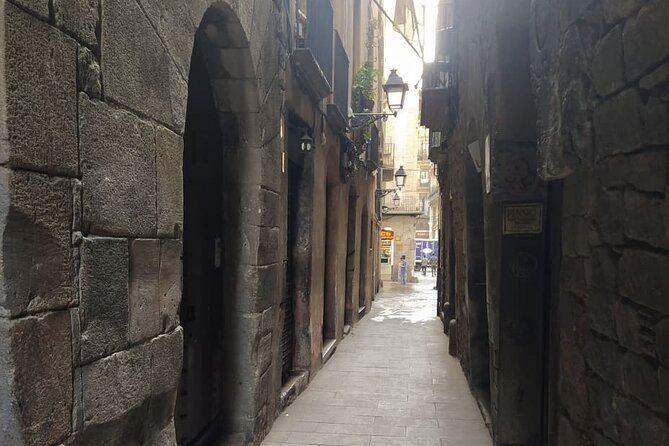
- Hidden-away squares and courtyards where Barcelona feels more intimate
- Stories with humor and context, not just dates and names
- A local chat vibe where you can ask anything, including why certain spots look the way they do
Walking Time That Actually Works in Barcelona’s Old Center
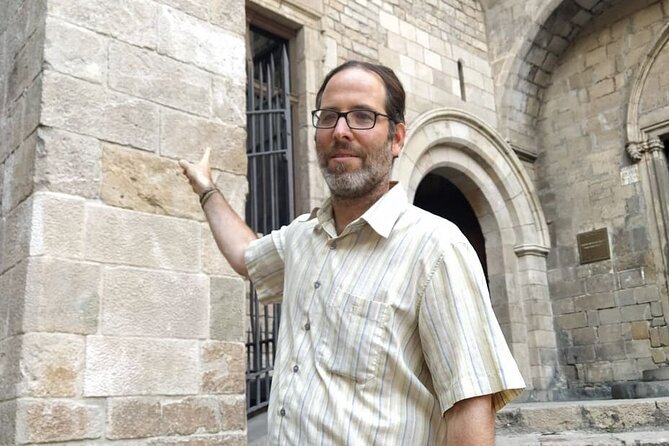
This tour is set up like a history course you can wander through. You start in Ciutat Vella at Pl. de Sant Jaume, and from there you bounce between plazas, courtyards, and a few key architectural spots. It’s designed to be paced—short stops, good explanations, and enough time to look around without feeling like you’re being dragged.
What makes it feel different is the approach: the guide connects what you see to what came before, and he keeps it conversational. In my kind of travel (and yours, I hope), that’s what turns a place from scenery into something you remember.
The whole thing is about 2 hours, and the timing stays reasonable: most stops land around 10–20 minutes. That matters because Barcelona can punish your schedule. A fast tour can turn into stress; a slow tour can turn into fatigue. This one lands in the middle.
You’ll also get a mobile ticket format, and you’re meeting right at a major central square, so it’s easy to orient yourself.
You can also read our reviews of more tours and experiences in Barcelona.

Starting at Pl. de Sant Jaume: Where Civic Power and Old Politics Sit Side by Side
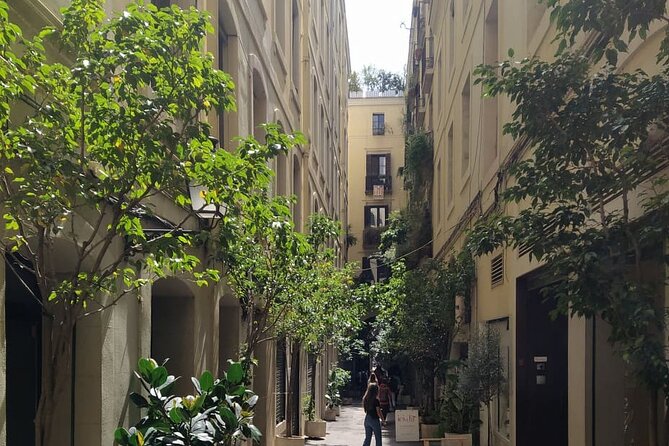
You begin at Pl. de Sant Jaume (Pl. de Sant Jaume, 3), the main square in Barcelona’s historic center. This is one of those places where architecture tells you what matters to the city: government buildings, official-looking facades, and the kind of square where people historically gathered for announcements and decisions.
Your guide uses this stop to set the stage. Instead of treating the square like a photo background, you’ll get context for why it became the main civic center—especially for Catalonia. It’s a good opening because it gives you a mental map: the Roman layers, the medieval power, and the later political story all start to make more sense when you begin here.
What I like: it’s not a random start point. It’s a place that already feels like a chapter of the city’s story.
MUHBA Temple d’August: The Roman Piece Barcelona Tries to Hide
Next comes MUHBA Temple d’August, a Roman temple site that’s famously easy to miss if you’re just strolling without clues. This is the kind of place where you can walk right past the evidence and only catch it if someone points you in the right direction.
The big value here is contrast. You’ll stand with Roman Barcelona in front of you, then you’ll look at the surrounding city and realize how much has grown over time. That feeling—realizing the “old” isn’t gone, it’s layered—makes the rest of the tour click.
This stop is brief (about 15 minutes), but it’s enough time to understand what the structure is, why it matters, and why it’s still such a conversation starter. And since the entry is listed as free, you’re not paying to learn a story you could easily miss on your own.
Possible drawback: if you hate short stops, you might wish this one got more minutes, because Roman sites reward slower looking.
Placa del Rei: Royal Power, and the Dark Parts Nobody Smiles About
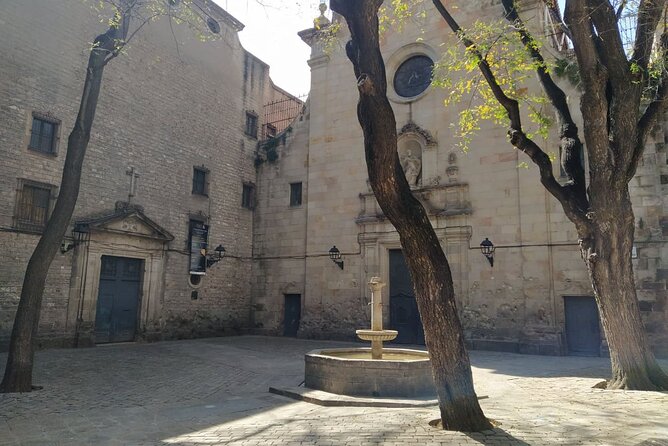
Then you move to Placa del Rei, a square tied to the palace area of the kings of Catalonia. This is medieval Barcelona’s “center stage” zone, but the guide doesn’t keep it clean.
You’ll hear about important historical events that included public executions—an example of how political power and public fear lived close together. That can be heavy, but it’s also honest. Barcelona’s story isn’t only art and sunshine; it’s also law, punishment, and control.
For me, this stop works because it changes your perspective. You stop thinking of the Gothic Quarter as just a backdrop for sightseeing and start seeing it as a place that shaped lives—sometimes violently.
You’ll likely spend about 15 minutes here, so it’s not meant to be a long lecture. It’s designed to give you the key meanings quickly, then let you look at the space and imagine the moments that happened there.
Barcelona Cathedral: A Major Church, With a Very Long Timeline
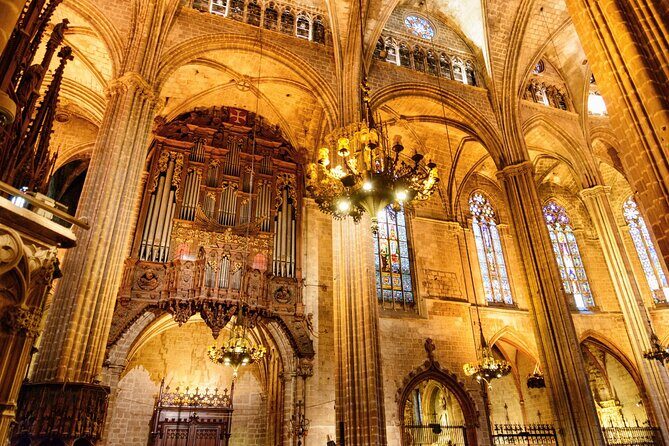
From the royal square, you head to Barcelona Cathedral. This is the most important church in Barcelona in the guide’s framing, and the tour treats it like more than a landmark you check off.
You’ll get a quick historical timeline and, in the guide’s information, the cathedral is described as going back to 1298 BC. Even if you personally treat that date as a starting point for curiosity, the takeaway is clear: this site carries deep time, and it has been reinterpreted and rebuilt through many eras.
This stop is around 15 minutes, so don’t expect a full-on interior tour time slot. What you get is the “why it matters” version, with enough context to help you understand what you’re seeing.
If you’re the type who likes to look at buildings and then asks why the design looks the way it does, you’ll probably enjoy this stop a lot.




Casa de l’Ardiaca Courtyard: Lawyer Guilds, a Mailbox, and Roman Clues
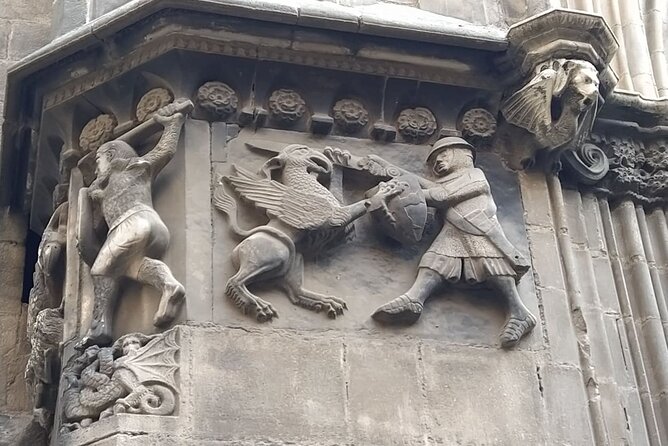
Next is Casa de l’Ardiaca, focusing on its courtyard. This is one of those Barcelona spaces that feels made for pausing. You’re not just viewing a facade; you’re looking at a quiet interior world where daily life and professional life once overlapped.
The story here centers on the guild of lawyers. Yes, lawyers—because in old cities, professionals helped shape culture and power, just like merchants and politicians did. You’ll also hear about a mailbox made by Lluís Domènech i Montaner, with a funny meaning behind it. That detail is exactly the kind of thing that makes a stop memorable: it’s specific and a little quirky, and it turns a courtyard into a real human place.
Then there’s another bonus: roman remains are described as hiding in the back. The courtyard becomes a mini “layer cake” of Barcelona’s past.
Time is about 15 minutes. That’s enough to absorb the courtyard vibe, learn the key connections, and still have energy for the next stop.
Placa Sant Felip Neri: Spanish Civil War Shadows and Movie-Made Sunshine
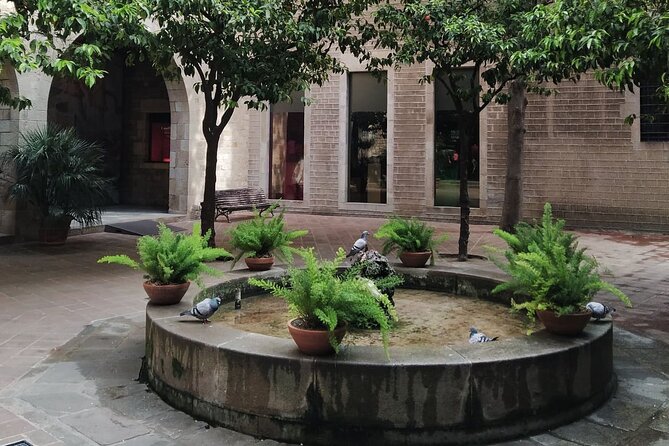
Placa Sant Felip Neri is described as a beautiful hidden square tied to a church and a school. It has a dark edge from the time of the Spanish Civil War, which your guide brings up as part of the place’s story.
Then the narrative shifts in a surprisingly practical way: the tour also mentions that a few movies were filmed here. That’s a great reminder that history is not frozen. A place can carry painful memories and still become a location people use for art and storytelling.
This stop is about 10 minutes, so you won’t get a long emotional lecture. You’ll get enough context to understand why the square feels a certain way, and you’ll get to see it with your eyes open rather than treating it like a random pause.
Pont del Bisbe: The 1929 Expo Bridge You’ll Want to Photograph
Now you’ll hit Pont del Bisbe, a real landmark bridge. This one has a clear reason for existing: it was made for the 1929 World Exposition. That fact alone gives you a useful frame—Barcelona built many visible symbols for big international moments, and this is one of the ways that energy shows up in everyday walking routes.
Your guide points out what makes it a “landmark” beyond the obvious postcard view. Even in a short 15-minute stop, you’ll get the why behind the design and location, not just the angle for your camera.
If you like bridges and street-level architecture (and who doesn’t in Barcelona?), this is a strong payoff after the quieter courtyards and squares.
Museu Frederic Mares: Inquisition Headquarters in a Quiet Patio
The last major story stop is Museu Frederic Mares. The tour frames it as a charming patio, but the story is heavy: it was the headquarters of the Spanish Inquisition in Barcelona.
That contrast—quiet courtyard space plus grim historical function—is part of the impact. Places like this are why guided context matters. Without it, the patio would feel like just another pretty interior; with the story, it becomes a site of power, fear, and procedure.
This stop runs around 15 minutes. You’re not being asked to sit for hours. Instead, you get the key facts and the atmosphere, and you leave with a better sense of how Barcelona’s religious and political forces shaped daily life.
Price and Value: What You’re Really Paying For
At $56.78 per person for about 2 hours, this tour sits in the sweet spot for value if you want guidance. All the stops are listed as free admission, so the price isn’t covering museum tickets—it’s paying for the time of the guide and the interpretation.
That interpretation is the real product here. You’re paying for:
- knowing what to look at when a site is easy to miss
- understanding why a square matters, beyond the obvious scenery
- hearing the darker chapters without turning the whole experience into gloom
It’s also private, meaning it’s not a “follow the herd” setup. That matters a lot in old Barcelona, where the best moments are often at small distances—around a doorway, in a courtyard corner, or at the edge of a square where you can’t see everything from the main street.
So yes, you’ll be walking between stops, but you’re not doing it blindly.
Who This Tour Fits Best (and Who Might Prefer Something Else)
This tour fits best if you:
- like history that connects architecture to real events
- enjoy short, focused stops instead of long museum marathons
- want to ask questions without feeling like you’re competing for attention
- prefer smaller, calm pacing over large-group rush
It’s also a good match for couples or friends who want a shared “story walk” with room to talk. One reason is the guide format: your group stays together, and you can chat naturally.
If you’re the type who needs big interior time—cathedral climbing, long museum viewing, or deep reading in one place—then you might feel limited by the brief stop structure. In that case, you could still enjoy the tour, but you’ll probably want to add a separate, longer visit to your favorite stop afterward.
The Little Extras That Make Adi’s Version Feel Human
In the reviews, the guide is described as friendly, funny, and easy to chat with. That lines up with what this kind of tour needs to work. History tours can become stiff. This one stays approachable.
Adi’s style also includes stopping for small local looks, like older shops you might not notice on your own, such as a long-running pharmacy. That kind of detour is small but meaningful. It adds texture and reminds you you’re in a living city, not a set made only for monuments.
If you enjoy those small moments, you’ll feel like you got a more personal Barcelona view than you’d get from a standard checklist tour.
Should You Book Hidden Barcelona? My Take
Yes, you should book this tour if you want a calm, private history walk that shows you Barcelona’s layers without making you choose between “big sights” and “quiet corners.” The mix—civic center, Roman remains, medieval power spaces, the cathedral, lawyer-guild courtyard details, war-era context, and the Inquisition headquarters—gives you a rounded sense of the city in just about two hours.
I’d skip it only if you strongly prefer long interior time at fewer sites, or if you don’t want any darker historical material mixed into the conversation. Otherwise, this is a smart way to get your bearings and learn what you’re actually looking at as you walk.
FAQ
How long is the Hidden Barcelona tour?
It lasts about 2 hours.
Is the tour private?
Yes. It is a private tour/activity, and only your group participates.
What language is the tour offered in?
The tour is offered in English.
Do I need to pay entry fees for the stops?
Admission ticket information for the listed stops is marked as free.
Where does the tour start?
The meeting point is Pl. de Sant Jaume, 3, Ciutat Vella, 08002 Barcelona, Spain.
Does the tour end back at the meeting point?
Yes, it ends back at the meeting point.
Is it possible to get a mobile ticket?
Yes, it’s listed as having a mobile ticket.
What is the cancellation policy?
Free cancellation is available up to 24 hours in advance for a full refund.
Are service animals allowed?
Yes, service animals are allowed.