Barcelona’s old layers are easy to miss.
This small-group Gothic Quarter and El Born walking tour turns quiet streets into a clear story you can follow block by block. I like that Luca keeps the pace friendly and makes the past feel practical, not just academic.
I also love the focus on real places, especially the free MUHBA stops like the Roman Temple d’August remains and the medieval Jewish quarter at El Call. The best part is you get multiple “wow” moments without needing to buy separate museum tickets.
One thing to consider: it’s a walking tour and it isn’t suitable for people with reduced mobility. If you use a wheelchair or need extra help, you’ll have to adapt the pace (and a private option may be needed).
In This Review
- Key highlights worth your time
- A 2h15 walk that stitches Barcelona’s past together
- Plaça de Sant Jaume: where Barcelona’s politics have lived for centuries
- MUHBA Temple d’August: the Roman layer hiding in plain sight
- Outside the Cathedral: Gothic architecture you can spot without tickets
- A key Gothic Quarter feature: the street puzzle pieces
- MUHBA El Call: reading a medieval Jewish neighborhood today
- Sant Felip Neri: Gaudí’s favorite church and a dark Spanish Civil War story
- El Born / La Ribera: medieval streets, plus the entertainment pulse
- Santa Maria del Mar and El Fossar de les Moreres: devotion and conflict in one walk
- Why Luca’s style makes the tour feel worth the time
- Price and value: what $13.27 buys you in Barcelona
- Practical tips so the walk feels comfortable, not exhausting
- Who should book this Gothic Quarter and El Born tour
- Should you book this tour?
- FAQ
- How long is Luca’s Hidden Old Barcelona: the Gothic and El Born Tour?
- What is the price per person?
- Is the tour offered in English?
- What’s included in the tour?
- Do I need admission tickets for the stops?
- Where does the tour meet?
- Where does the tour end?
- What group size should I expect?
- Is the tour suitable for reduced mobility, and are service animals allowed?
- What’s the cancellation window for a full refund?
Key highlights worth your time
- Luca’s energy and humor: the guide is lively, asks questions, and uses lots of visuals to explain what you’re seeing
- Free MUHBA stops: Roman columns and the medieval Jewish neighborhood without extra admission costs
- Gaudí’s favorite church stop: Sant Felip Neri adds both beauty and unsettling context
- A route tied to Catalan politics: from Plaça de Sant Jaume to El Fossar de les Moreres
- Ends near Mercat del Born: you finish in the heart of the Born where it’s easy to keep exploring
A 2h15 walk that stitches Barcelona’s past together
This tour is built for people who want the city to make sense fast. In about 2 hours 15 minutes, you cover the old center on foot, with a professional guide leading a tight path through Barcelona’s “main characters”: Roman remnants, medieval neighborhoods, and the power struggles that still shape how people talk about the city.
The group is capped at 15 people, which matters. Big coach tours can feel like you’re sprinting past stonework. Here, you can actually pause, look up, and ask questions. That’s a big deal in Barcelona because the streets fold and twist, and the “what am I looking at?” moments happen constantly.
It’s offered in English, and you get a mobile ticket. That’s helpful when you’re moving through dense neighborhoods and don’t want to juggle paper confirmations.
If you like walking tours, this one hits a sweet spot: enough time to feel the logic of the area, but short enough that you’re not cooked by the end. Some people also note it covers roughly a few miles on foot, which feels about right for a focused Gothic-and-Born loop.
You can also read our reviews of more tours and experiences in Barcelona.
Plaça de Sant Jaume: where Barcelona’s politics have lived for centuries
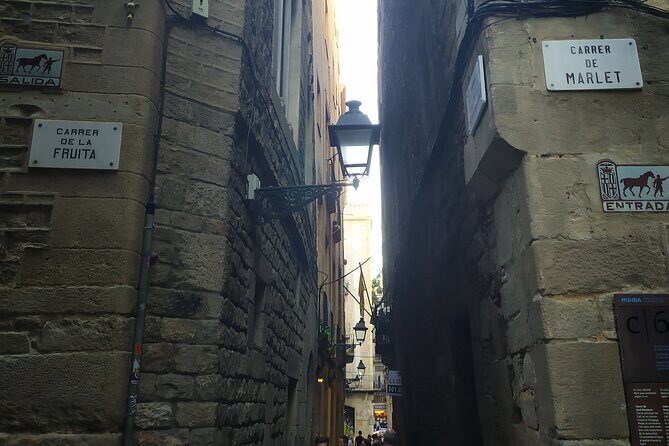
The tour begins at Pl. de Sant Jaume (3, Ciutat Vella). This is the political and social center for around 2,000 years, and Luca sets the tone by helping you read the square like a map.
Here’s what you should pay attention to: civic buildings aren’t just architecture. They’re stage sets for how power was shown, claimed, and defended. You’ll see the town hall area and the regional government presence right in the square, and it quickly explains why this part of the city matters even when you’re just wandering.
Even if politics isn’t your favorite topic, this stop gives you a baseline. You start the walk understanding who had authority, and later stops about conflict don’t feel random. They feel like chapters that connect.
MUHBA Temple d’August: the Roman layer hiding in plain sight
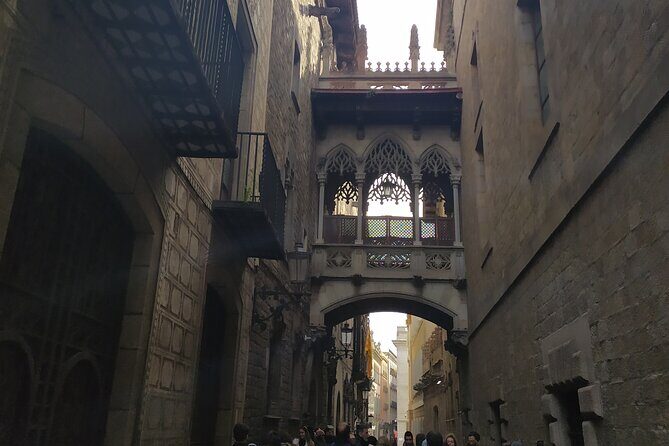
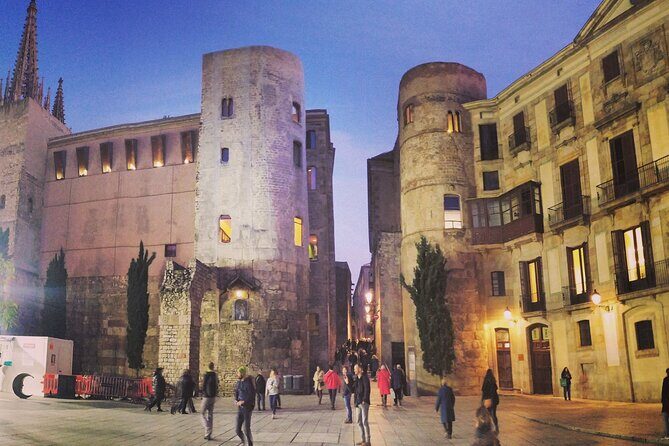
Next up is MUHBA Temple d’August, a stop built around four ancient columns from the huge temple of Augustus. The idea here is simple and effective: you’re not just looking at a Gothic street. You’re standing over a much older Barcelona.
This is one of those “how can this be here?” moments that makes the tour worth doing even if you think you’re not a museum person. Roman ruins in the middle of a living city can feel like decoration. Luca helps make them feel like infrastructure—something that organized space, movement, and belief long before the medieval city grew around it.
Admission here is listed as free, so you can treat it like a bonus stop rather than a required ticket purchase.
Outside the Cathedral: Gothic architecture you can spot without tickets
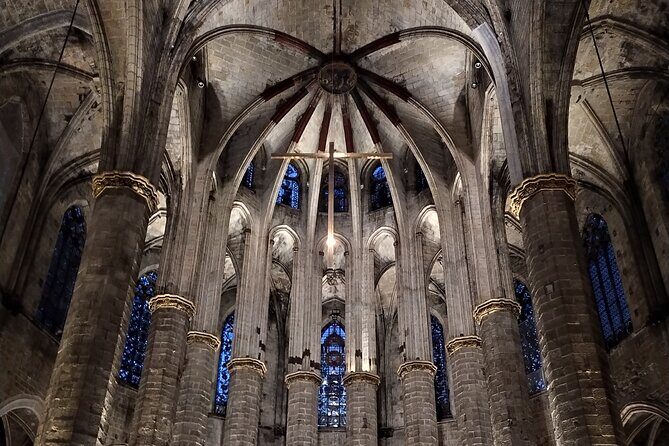
Then you shift to the Catedral de Barcelona area. You’ll explore the outside of the cathedral—no inside ticket included. That’s actually a smart choice for a walking tour because it keeps momentum and avoids line-time.
When you’re outside, the key is learning what to look for:
- Gothic shapes often feel “vertical” and purposeful, like stone designed to pull the eye upward
- The cathedral area is also about the street pattern around it, not just the facade
If you want more cathedral time later, you can add it on your own after the walk. For this experience, the value is the orientation: you get a framework for seeing why the Gothic quarter feels different from other parts of the city.
A practical note: if you’re sensitive to heat, this part of the walk can expose you to sun, since you’re moving through open street sections rather than staying under cover.
A key Gothic Quarter feature: the street puzzle pieces
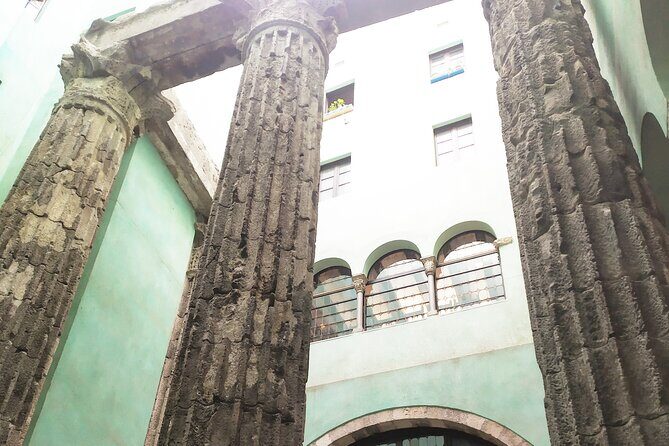
The route includes one of the main features of the Gothic Quarter—an anchor moment in the maze of lanes. I like this part of the design because it helps you avoid the “pretty streets, but I’m lost” feeling.
Barcelona’s old quarter is not laid out like a grid. It’s built like a puzzle box. Having a guide point out a signature Gothic element (and connect it to what came before) turns wandering into understanding.
Even if your walking tour stops feel like they’re repeating a theme—stone, arches, and narrow lanes—that doesn’t mean the tour is stuck. It means you’re getting a pattern: architecture as evidence of how Barcelona worked, argued, and adapted over time.




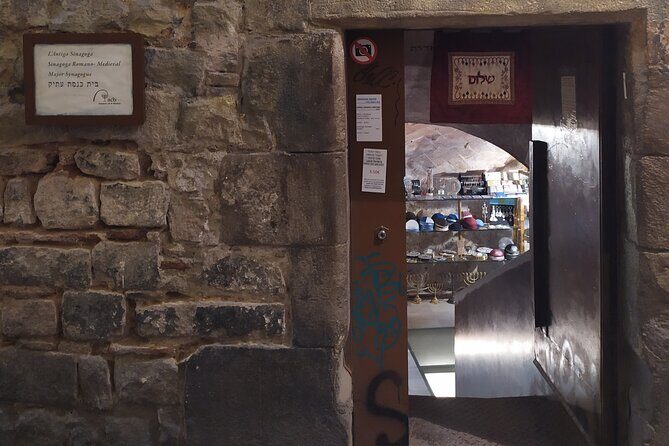
MUHBA El Call: reading a medieval Jewish neighborhood today
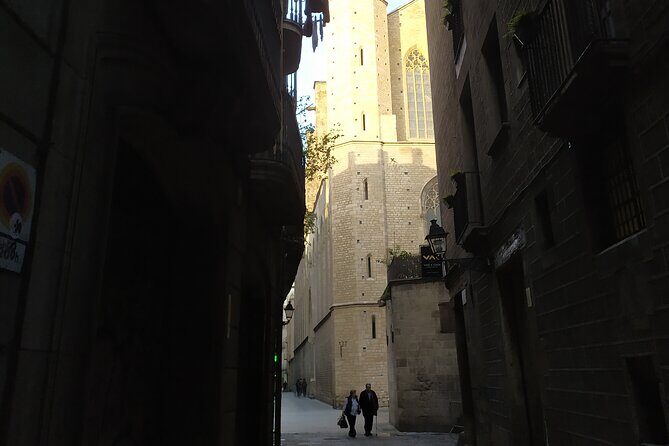
After that, you go to MUHBA – El Call, the Medieval Jewish Neighbourhood. This stop adds an important layer that many visitors skip because it’s not always the loudest part of the quarter visually.
What you should take away: neighborhoods carry history even when the modern street looks simple. The El Call stop helps you connect people, community life, and how cities change when different groups rise, endure, or are pushed aside.
Admission is free here too, which makes this one of the tour’s best value moves. You’re getting a major slice of Barcelona’s past without adding cost or requiring you to plan a separate visit later.
If you want a Barcelona that feels human—not just royal and church-focused—this is a key reason to book the tour.
Sant Felip Neri: Gaudí’s favorite church and a dark Spanish Civil War story
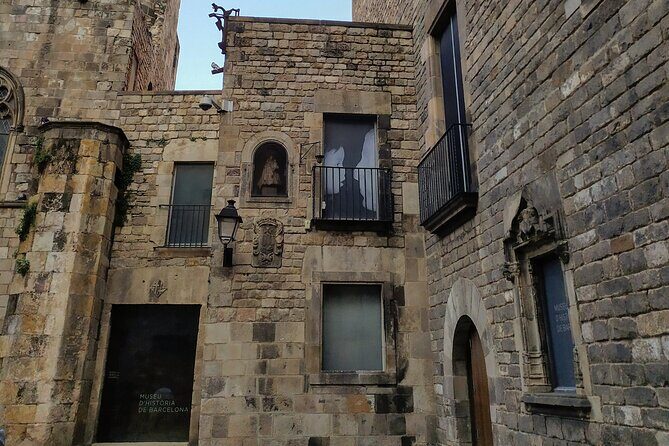
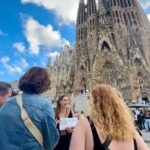
One of the most memorable stops is Esglesia de Sant Felip Neri. The tour frames it as Gaudí’s favorite church during his lifetime, and it’s easy to see why. It also sits in one of those small old-city squares that feels like it was designed for quiet pauses.
Then Luca adds the weight: the area has a dark recent past, connected to the Spanish Civil War. That contrast is the point. Barcelona isn’t only a postcard of beautiful buildings. It’s also a place that carries real trauma and complicated memory in public spaces.
Admission is listed as free for this stop, and the short time here works well. You get enough context to understand why this place is more than pretty walls, and then you move on without dragging the experience.
El Born / La Ribera: medieval streets, plus the entertainment pulse
The tour spends about 30 minutes in El Born / La Ribera, an important medieval neighborhood. This is where the tour starts to feel less like “history class” and more like “walk through how the city lived.”
The Born has a different mood than the Gothic quarter. It feels more everyday, even when you’re standing in historic spaces. That’s why it’s a good pairing with the heavier political and religious stops earlier. The tour balances hard topics with the feeling of lived-in streets.
It also includes Passeig del Born, described as a medieval entertainment square of Barcelona. That detail matters because it reminds you: these weren’t just places of ceremony. People gathered to watch, socialize, and pass time. When a guide points that out, you start imagining the volume in the streets instead of treating them like dead sets.
Santa Maria del Mar and El Fossar de les Moreres: devotion and conflict in one walk
The final major religious stop is Basilica de Santa Maria del Mar, described as the most loved church in Barcelona. Even if you’re not a religious architecture person, the focus here is how people relate to places. A loved church isn’t just a building; it’s part of community identity.
Then you head to El Fossar de les Moreres, which is framed as fundamental for understanding the political conflict between Madrid and Barcelona. That’s a strong way to end the historical storyline because it ties the medieval quarter to modern political tension.
The value here is that the walk doesn’t treat conflict as a vague theme. It points you to a specific place that anchors it. After this, you’ll notice that Barcelona’s debates don’t float in the air. They’re connected to physical locations you can stand on.
You finish near El Born Centre de Cultura i Memòria, by Mercat del Born—a great spot to continue with lunch, a snack, or a final loop through the streets.
Why Luca’s style makes the tour feel worth the time
A good walking guide does more than list facts. Luca’s approach stands out for a few practical reasons.
First, he links details so your brain doesn’t have to hold everything. You hear the reason this square mattered, then later you see how the theme shows up again in another stop. The route feels like it has a spine.
Second, the delivery is energetic. People often mention that Luca brings passion and humor, and that he checks in with questions. That keeps the tour from turning into one-way lecturing.
Third, he seems to use lots of reference visuals and answers follow-ups with real care. Even if some of the big ideas are familiar, the added depth—like explaining what makes Gothic features real versus later imitations—helps you see with sharper eyes when you keep wandering after the tour ends.
Price and value: what $13.27 buys you in Barcelona
At $13.27 per person for about 2 hours 15 minutes, the price is low enough that you don’t feel like you need to “justify” every minute.
The bigger value isn’t only the cost. It’s that you’re getting:
- multiple themed stops in a dense area
- a professional guide for the whole run
- free MUHBA stops as part of the route
- outdoor focus where you don’t need to buy separate indoor tickets
You also get a coherent path. In the Gothic quarter, it’s easy to spend hours making a loop that doesn’t help you understand anything. Paying for a guide is basically paying for time efficiency and context.
One more practical point: the tour is often booked about 26 days in advance on average. That doesn’t mean you’ll never find space, but it’s another hint that you should reserve early, especially if you’re traveling in peak weeks.
Practical tips so the walk feels comfortable, not exhausting
A walking tour in Barcelona can be glorious. It can also be sweaty. One common complaint is that sunny exposure can get intense, especially in hotter weather when the route runs through open streets.
To make the day easier, I’d plan like this:
- Wear light layers and bring water. The route is on foot, with stops that don’t fully block sun.
- Use good walking shoes. Old-city streets can be uneven, and you’ll be on them for most of the 2h15.
- If you’re planning to tour further afterward, save your heavy museum time for another part of the day. This is your “orientation walk.”
If you’re traveling solo or as a couple, this is also a great first-day option. It helps you understand where to roam next without feeling like you’re chasing random scenery.
Who should book this Gothic Quarter and El Born tour
This one fits best if you:
- want a structured introduction to the Gothic Quarter and El Born
- like history tied to places you can actually stand on
- enjoy politics, architecture, and community stories more than just selfies
- want insider-style guidance for what to do next after the walk
It may feel less ideal if you need long pauses, step-free routes, or very slow pacing. The tour isn’t suitable for reduced mobility, though the operator notes they can adapt for your pace if needed (and a private experience could be arranged).
If you’re okay with walking and can handle uneven old streets, you should be in good shape.
Should you book this tour?
If you want a fast way to understand why Barcelona’s old center feels the way it does, book it. The price is friendly, the group size stays small, and the route covers both the pretty and the complicated parts of the city—Roman remains, medieval communities, church beauty, and the story of conflict tied to real locations.
The only real “no” is physical comfort. If reduced mobility is a concern, check options early so the experience can be adapted properly.
If you’re ready to walk with a guide named Luca and come away seeing the Gothic quarter with smarter eyes, this is a strong choice.
FAQ
How long is Luca’s Hidden Old Barcelona: the Gothic and El Born Tour?
It runs for about 2 hours 15 minutes.
What is the price per person?
The price listed is $13.27 per person.
Is the tour offered in English?
Yes, it’s offered in English.
What’s included in the tour?
A professional guide is included.
Do I need admission tickets for the stops?
Many stops have admission tickets listed as free, but the cathedral stop is listed as admission not included because you only explore the outside.
Where does the tour meet?
The meeting point is Pl. de Sant Jaume, 3, Ciutat Vella, 08002 Barcelona, Spain.
Where does the tour end?
The tour ends at El Born Centre de Cultura i Memòria, Mercat del Born, Plaça Comercial, 12, Ciutat Vella, 08003 Barcelona, Spain.
What group size should I expect?
The tour has a maximum of 15 travelers.
Is the tour suitable for reduced mobility, and are service animals allowed?
The tour is not suitable for people with reduced mobility, but it notes it can adapt to your own pace. Service animals are allowed.
What’s the cancellation window for a full refund?
Free cancellation is available up to 24 hours in advance for a full refund. Cancel at least 24 hours before the start time to get your money back.