REVIEW · BARCELONA
Raval Street Art and Graffiti Guided Tour in Barcelona
Book on Viator →Operated by Street Art Barcelona · Bookable on Viator
Barcelona’s street walls talk.
This 2-hour Raval street art and graffiti walk is built for people who like seeing the city through what’s happening on the ground, not just in guidebooks. I like that it stays small (max 15), so your guide can point out details and keep the conversation going while you’re moving between murals, stickers, and painted corners. You also get guide-led context on the artists and what the work is saying in this neighborhood.
What’s especially fun is the human side of the route. One review-worthy touch is the stop at the legendary skate spot Tres Chemineas, where the area’s creative energy feels less like watching and more like hanging out. You’ll also hear guide stories from people like Juan (a street artist himself) and Olga, plus names such as Jeanne, Anaïs, Jan, Cynthia, and others showing up in guest feedback.
One consideration: meeting points can be confusing if you arrive at the wrong end of the walk. A couple of reviews mention navigation confusion due to the map in the app showing the ending location instead of the start, so take a moment to confirm you’re at the beginning before you go wandering.
In This Review
- Key things to look for on this Raval street art walk
- Why Raval street art feels more real than the postcard stuff
- Meeting point at Jardins Tàlia (Sant Antoni): start clean, then enjoy
- The first stretch: “popular neighborhood” energy and city-center texture
- Hanging at Tres Chemineas: the stop that makes it feel local
- Learning to read street art: artists, techniques, and social meaning
- Ending at Museu d’Art Contemporani de Barcelona: a clean finish near the action
- Price and value: paying for access to interpretation
- What to expect from your guide (based on real guest experiences)
- Walking pace, photos, and comfort: simple expectations
- Who should book this Raval street art tour—and who should skip it
- Should you book this Raval Street Art and Graffiti Tour?
- FAQ
- How long is the Raval street art and graffiti guided tour?
- What’s the price per person?
- How big is the group?
- Is the tour in English?
- Where do I meet, and where does the tour end?
- What’s included in the tour price?
- Is food or hotel pickup included?
Key things to look for on this Raval street art walk
- Max 15 people keeps the pace personal and photo-friendly
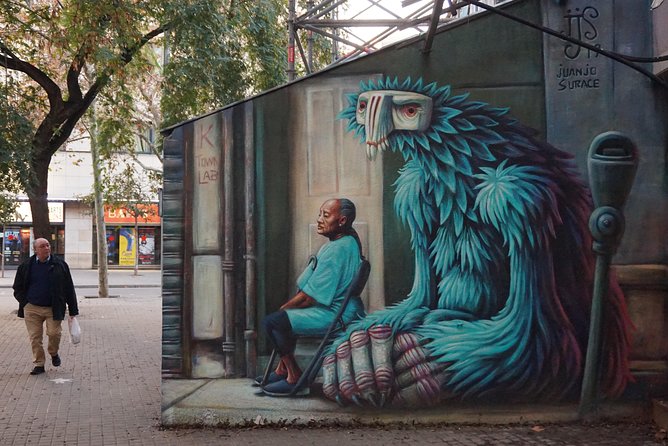
- Artist stories help you read murals, tags, and stickers as messages, not just decoration
- Tres Chemineas gives you a real local-creativity vibe beyond the tourist photo spots
- Raval back streets show older buildings and street-level life that you’d probably miss alone
- Guides with street ties: reviews mention guides like Juan and Olga with strong community insight
Why Raval street art feels more real than the postcard stuff
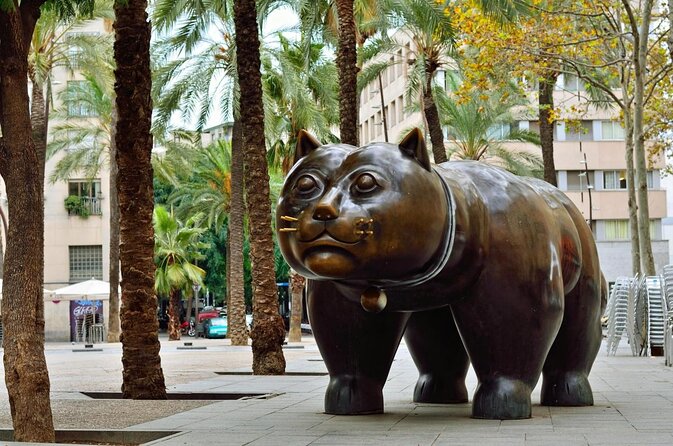
Raval is one of those Barcelona neighborhoods where the walls don’t just decorate. They comment. They argue. They remember. And they change. That’s exactly why a guided street art tour can feel more informative than a museum day: you’re learning the city by looking at what’s being made right now.
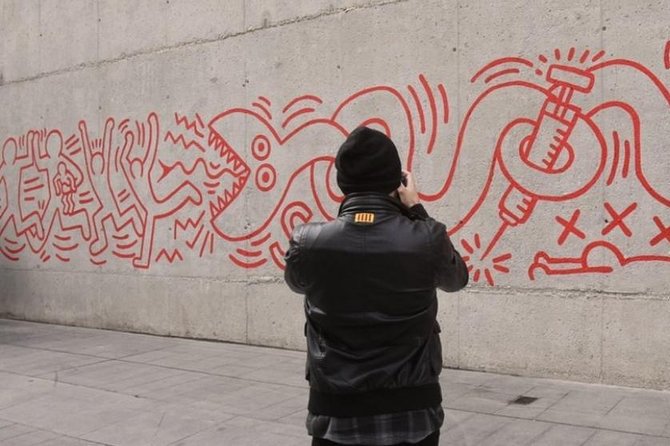
What I like about this kind of tour is that it treats street art as a mix of culture, design, and social talk. In the best stops, your guide connects the dots between styles and the people behind them. You get a sense of how graffiti and street murals can act like a public bulletin board, except the handwriting is bold and the art form is the headline.
This is also a strong match if you like walking. The tour is designed as a loose, stop-and-look route through central Barcelona, with enough movement to keep energy up and enough pausing to actually notice things. If you normally zoom past shutters, paste-ups, and street signs, you’ll probably slow down after the first few minutes.
You can also read our reviews of more tours and experiences in Barcelona.



Meeting point at Jardins Tàlia (Sant Antoni): start clean, then enjoy
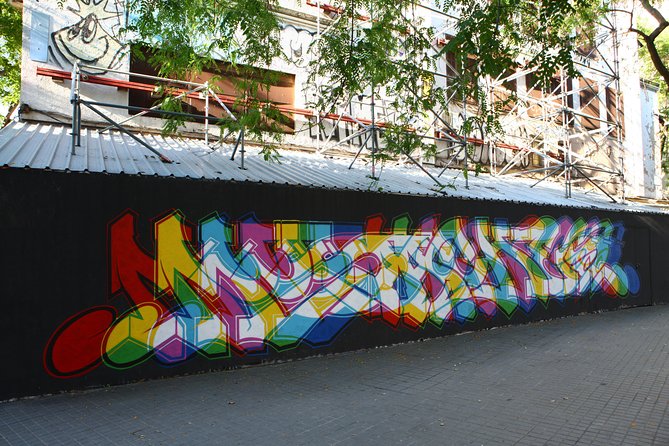
The walk starts at Jardins Tàlia, Sant Antoni (Eixample), 08015 Barcelona, and it ends at Museu d’Art Contemporani de Barcelona, Plaça dels Àngels, 1 (Ciutat Vella), 08001. No hotel pick-up, so you’ll want to arrive on your own and build in a little buffer.
Two practical tips that save stress:
First, confirm you’re at the start, not the end. A recurring theme in feedback is that navigation in the app can point to the ending spot. If you show up there, you may end up 15–20 minutes away by subway, and that adds unnecessary scrambling.
Second, if you’re meeting a guide, arrive a few minutes early and let the neighborhood do the work. This area isn’t hard, but it’s easy to overthink it. Give yourself time to find the right patch of street and then you can relax.
The first stretch: “popular neighborhood” energy and city-center texture
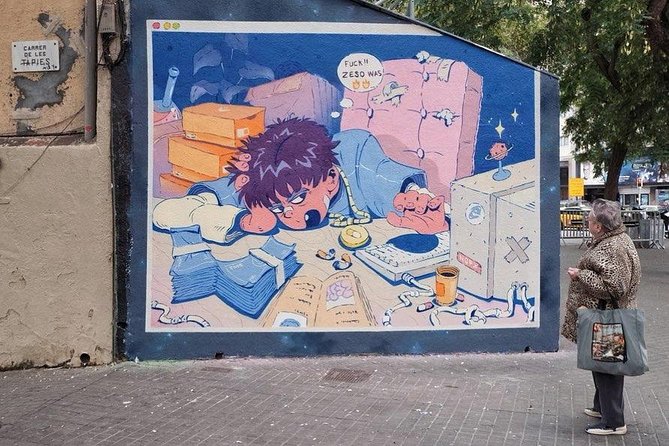
Early on, the tour focuses on the city center flavor of Raval—more local, less polished, and full of small visual details. This is where a good guide matters most, because street art is often hiding in plain sight. You’ll be scanning for things that don’t immediately look like “art,” like paste-ups above street signs or tags along edges you’d normally ignore.
If you’re the type who likes context, this opening portion is where it pays off. Your guide is setting up how to look: what to notice, how to compare styles, and how to think about why an artist might place a piece where they do. In one guest’s experience, the route included lots of Rambla-area art and discussion of the broader Barcelona street art community, which is a great way to connect neighborhood pieces to the bigger scene.
Possible drawback here: if you expect a tour that’s mostly about big, famous murals with minimal walking, this first stretch may feel more observational. The value is in learning to see—small surfaces matter.
Hanging at Tres Chemineas: the stop that makes it feel local
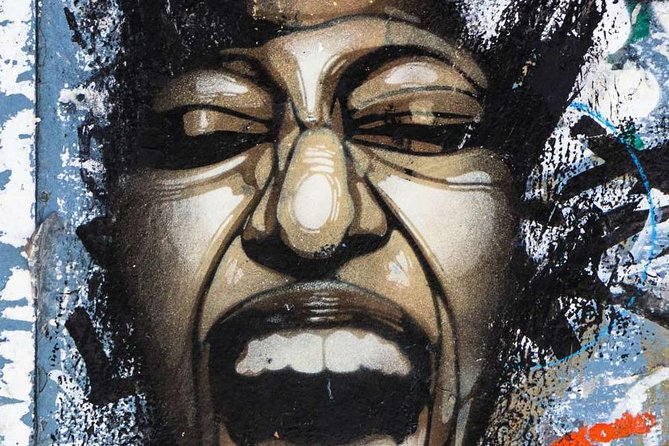
One of the headline moments is time spent at Tres Chemineas, described as a legendary skate spot. This matters because skate culture and street art often share the same ecosystem: public space, creative identity, and the idea that the city is a canvas you can use.
On this tour, that stop works like a pause from the constant scanning. Instead of only looking at art, you’re experiencing a place where creativity lives in everyday behavior. Even if you’re not a skater, you’ll get why the spot has a reputation—your guide can explain the culture around it, not just point at a wall.
From a practical standpoint, it’s also a good “reset” moment. After the earlier blocks of street-level artwork, this helps you absorb what you’ve seen and connect it to the neighborhood vibe.
If you’re the kind of traveler who loves authenticity over perfect views, this is the part that tends to land hardest. It’s not an exhibit. It’s a place where people gather.
Learning to read street art: artists, techniques, and social meaning
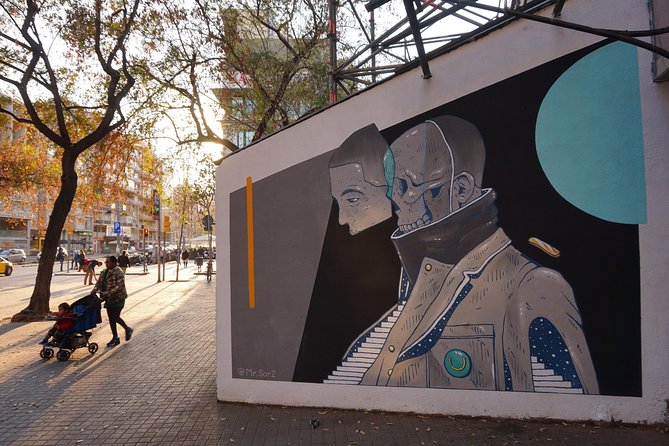
The tour isn’t just a photo walk. It’s a guided interpretation of the art scene, including details about the artists and how the works function in Barcelona’s street life.
In reviews, the strongest praise is about guides who can make the art readable. People specifically mention guides explaining different types of street art and sharing stories that turn murals and graffiti into something you can understand at a glance later in the trip. One guest said the tour changed how they saw the city, and that’s exactly what you want from a short experience.
Here are the kinds of “reading skills” you should walk away with:
- how to spot different styles (not every tag is the same message)
- why an artist might use a certain surface or location
- how the work can carry social commentary, not just aesthetic choice
- why street art changes over time (so it’s part of living Barcelona)
Some guides have especially strong street connections. Reviews mention Juan, a street artist himself, bringing an insider’s perspective. Others highlight Olga and Jeanne for their depth and storytelling. When your guide can explain technique and intent, you stop treating street art like random decoration and start treating it like communication.





Ending at Museu d’Art Contemporani de Barcelona: a clean finish near the action
The tour ends at Museu d’Art Contemporani de Barcelona in Plaça dels Àngels. That’s a convenient way to wrap up: you finish near a central area, which makes it easier to keep exploring by foot or quick transit.
This ending also creates a nice contrast. You start in lived-in street space, and you finish near a contemporary art setting. Even if you don’t go into the museum, the location helps you connect the dots between street art and the broader art world.
One practical benefit: ending near Plaça dels Àngels means you can easily pivot into food, shopping, or a next sightseeing stop without feeling trapped at the end of a long detour.
Price and value: paying for access to interpretation
At $32.58 per person for about 2 hours, the price is in the sweet spot for an experience like this. You’re not paying for transportation or a fancy ticket package. You’re paying for two things that are hard to replicate on your own:
1) a guide to point out what to see
2) context that turns scattered street art into a coherent story
Because the group is capped at 15, that per-person cost often feels more fair. Smaller groups tend to mean fewer people blocking the guide’s attention and more chances to ask questions. Several reviews emphasize that the guides were detailed, attentive, and made the tour feel worth more than the price (including for people who did other major attractions like Sagrada Família).
Could you DIY this with a phone and random walking? Sure. But street art is constantly shifting, and context is the difference between admiring and understanding. A guided route helps you notice faster, photograph better, and connect the work to the neighborhood story you’re actually standing in.
What to expect from your guide (based on real guest experiences)
Your guide leads the route and provides local insight. The included portion centers on learning the Barcelona street art scene and artistic talent in less-obvious corners of Raval.
Names that show up repeatedly in reviews include:
- Juan (mentioned as a street artist himself)
- Olga
- Jeanne
- Anaïs
- Jan
- Cynthia
Not every guide will deliver the exact same pace or route detail, but the general pattern across feedback is consistent: people appreciated strong storytelling and explanations of artists and art styles.
One “extra-interest” detail mentioned in feedback: a guide may be able to make a special detour tied to a community space and a gated garden connection (you’d likely need a key and local knowledge). Don’t treat that as guaranteed. But it’s a good example of why having a guide with real ties can add moments you wouldn’t find alone.
Walking pace, photos, and comfort: simple expectations
This is a walking tour, around 2 hours. There’s no hotel pickup. You should plan to dress for street-level exploring.
If you care about photos, this format can be ideal. Guests mention getting lots of photos and appreciating how much there is to notice once you know what to look for. Street art offers plenty of close-up angles, textures, shutters, and layered pieces—especially in older back streets.
Group size also helps the photo situation. With a small group, you’re less likely to feel like you’re being rushed or squeezed.
A minor heads-up: one guest’s experience included a delayed start, and another mentioned confusion about the meeting point. Those are not issues you should expect every time, but they’re reasons to show up early and keep your phone handy.
Who should book this Raval street art tour—and who should skip it
Book it if you want:
- a short, high-impact way to understand Raval beyond the usual tourist loop
- a guide-led route that teaches you how to look at street art
- plenty of storytelling and context tied to artists and neighborhood life
- a day that mixes art with local culture at places like Tres Chemineas
Skip or consider carefully if you:
- want a mostly “sit down and view” experience
- dislike walking through mixed-use city streets
- only want famous landmarks and zero surprises
It also works well early in your trip. One review specifically recommended doing it early because it changes how you notice street art later across the city.
Should you book this Raval Street Art and Graffiti Tour?
My take: yes, if you like street-level art and you want real context fast. The combination of a small group, a 2-hour walk, and guide storytelling is built for value. At $32.58, you’re paying for interpretation, not just access to murals.
The one thing I’d be strict about is the meeting point. Double-check that you start at Jardins Tàlia (Sant Antoni) and not at the ending area near the museum. If you nail that, you’ll likely get a tour that makes Raval feel like a living gallery rather than a random street backdrop.
FAQ
How long is the Raval street art and graffiti guided tour?
It runs for about 2 hours.
What’s the price per person?
The price is $32.58 per person.
How big is the group?
The tour has a maximum of 15 travelers.
Is the tour in English?
Yes, it’s offered in English.
Where do I meet, and where does the tour end?
Meet at Jardins Tàlia, Sant Antoni, Eixample, 08015 Barcelona. The tour ends at Museu d’Art Contemporani de Barcelona, Plaça dels Àngels, 1, Ciutat Vella, 08001 Barcelona.
What’s included in the tour price?
It includes a local guide and time spent discovering artistic talent in Raval, plus learning about the Barcelona street art scene.
Is food or hotel pickup included?
No. There’s no hotel pickup or drop-off, and extra food and drinks aren’t included.