REVIEW · BARCELONA
Barcelona in 2 Hours: Guided Walk Through History and Sights
Book on Viator →Operated by Carpe Diem Tours · Bookable on Viator
Two hours, and Barcelona starts making sense. This guided walk focuses on stories behind the landmarks in Ciutat Vella, from the artist-studded Els 4 Gats to Catalan identity tied to September 11, 1714. You get an English-speaking local guide, a route that stays walkable and compact, and lots of stops where you can focus on meaning, not just photos.
I especially like two things. First, the way the guide links each place to Catalan culture and major turning points, like Saint Eulalia at the Catedral de Barcelona and the symbolism behind El Mon Neix En Cada Besada. Second, the pacing works for real travel days: about 10 minutes per stop, so you can see a lot of old-town layers without exhausting your legs.
One consideration: two churches have admission that is not included (Catedral de Barcelona and Basilica de Santa Maria del Mar), and you will be walking on uneven, historic streets. Also, if you need crisp audio, keep in mind that one group noted street noise and no speaker/audioguide, so your experience may depend on where you stand.
In This Review
- Key highlights worth your time
- A fast, story-first tour that keeps you moving
- Where the walk starts and ends in Ciutat Vella
- Stop 1: Els 4 Gats and the artist hangout vibe
- Stop 2: El Mon Neix En Cada Besada and the La Diada link
- Stop 3: Catedral de Barcelona and Saint Eulalia’s martyr story
- Stop 4: Casa de l’Ardiaca and the Roman water remnants
- Stop 5: Pont del Bisbe and the superstition moment
- Stop 6: Placa Sant Felip Neri and a scarred political past
- Stop 7: MUHBA – El Call and medieval street memory
- Stop 8: Plaça de Sant Jaume and the government-culture contrast
- Stop 9: Plaça del Rei and the shadow of the Spanish Inquisition
- Stop 10: Plaça de l’Àngel and the miracle renaming
- Final stop: Basilica de Santa Maria del Mar and Barcelona by sea
- What you should expect from your English-speaking guide
- Price: how $22.99 can actually be good value
- Who this 2-hour walk is best for
- Should you book Barcelona in 2 Hours?
- FAQ
- How long is the Barcelona in 2 Hours guided walk?
- Where does the tour start and where does it end?
- Is the tour in English?
- Are entrance tickets included for the cathedral and Santa Maria del Mar?
- How many people are in the group?
- Is there free cancellation?
Key highlights worth your time
- A concentrated Gothic Quarter and El Born route that connects art, politics, religion, and everyday life
- Els 4 Gats explained as an artist meeting place, tied to names like Picasso and Gaudí
- El Mon Neix En Cada Besada with the deeper story behind La Diada (Catalonia Day), not just Instagram value
- MUHBA – El Call read through medieval street form and the history of Barcelona’s Jewish community
- Multiple Catalan government and power squares (Sant Jaume and Sant Felip Neri themes) that show celebration and protest side by side
- Finish at Santa Maria del Mar so your last big impression lands in the maritime, El Born mood
A fast, story-first tour that keeps you moving
This isn’t one of those tours that hands you a list of monuments and sends you on your way. The whole point here is to help you understand Barcelona’s old core. You walk through the Gothic Quarter and nearby El Born, but the guide’s main job is to connect what you see to why it matters.
Price-wise, you’re paying for guidance that saves time and turns confusing streets into a route with a point. With a max of 20 people, it also feels manageable. You’re not trying to hear a foghorn while 50 strangers shuffle like a single organism.
If you like your travel days active but not punishing, this fits well. It’s a smart way to get oriented early in a trip, because so many of the landmarks and street patterns you’ll see again later start making sense.
You can also read our reviews of more tours and experiences in Barcelona.
Where the walk starts and ends in Ciutat Vella
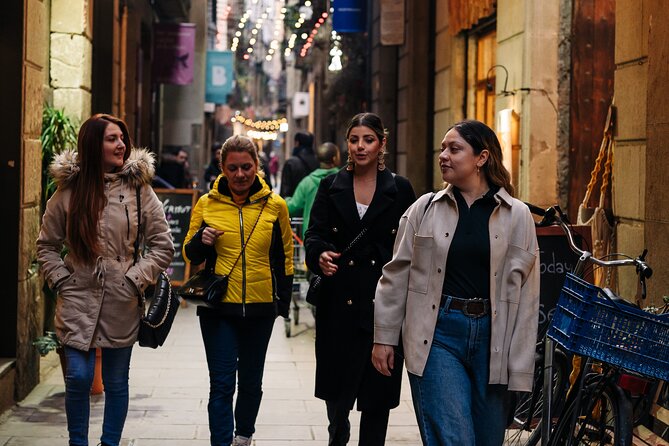
You meet at Plaça del Vuit de Març in Ciutat Vella (08002). The walk ends at Basílica de Santa Maria del Mar, Plaça de Santa Maria 1 (08003). That start-to-finish flow matters: you’re walking through the older city fabric without doing heavy backtracking.
The tour is near public transportation, and you get a mobile ticket, so you’re not fumbling with paper on a sidewalk. Also, the start/end points both sit in the kind of area where you’ll likely want to keep walking after the tour for coffee or a second look at a square.
Stop 1: Els 4 Gats and the artist hangout vibe
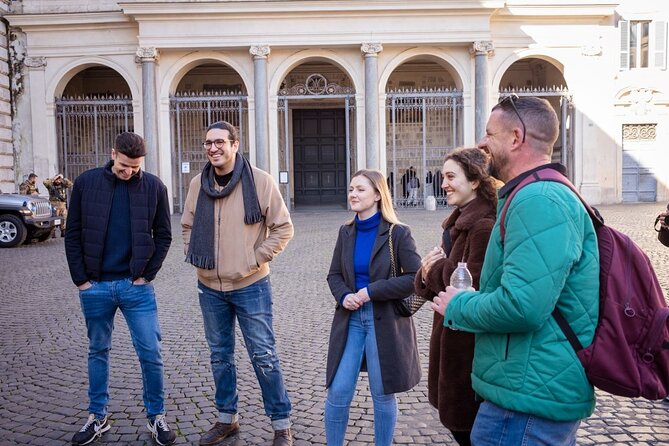
Els 4 Gats is famous, but it’s more than a pretty façade. This historic café and restaurant has Art Nouveau design outside and a reputation as a meeting place for big thinkers. The guide brings the story into focus, including the fact that artists such as Pablo Picasso and Antoni Gaudí were associated with the atmosphere around it.
Why this stop works: it shows you that Barcelona’s identity isn’t only about buildings. It’s about people clustering around ideas. Even if you’ve seen the name before, you’ll usually come away with a clearer picture of why the city became a magnet for artists and creators.
Practical note: admission is listed as free here, and you only spend about 10 minutes—enough time for orientation and story, not enough time to turn it into a long café detour unless your guide allows a quick pause.
Stop 2: El Mon Neix En Cada Besada and the La Diada link
This photomosaic is the kind of thing you might spot online and walk past. Don’t. The guide connects it to a much sharper historical thread: it’s tied to the Catalan defeat on September 11, 1714. That event is part of what later sparked La Diada—Catalonia Day—an annual moment of remembrance and identity.
What I like about this stop is the balance. Yes, it’s visually striking, but it’s also a reminder that Barcelona’s street art and public symbols often point back to politics, grief, and celebration. You’ll look at the mosaic details differently once the story is in your head.
This is also a free admission stop, which helps if you’re trying to keep the budget tight while still seeing the right places.
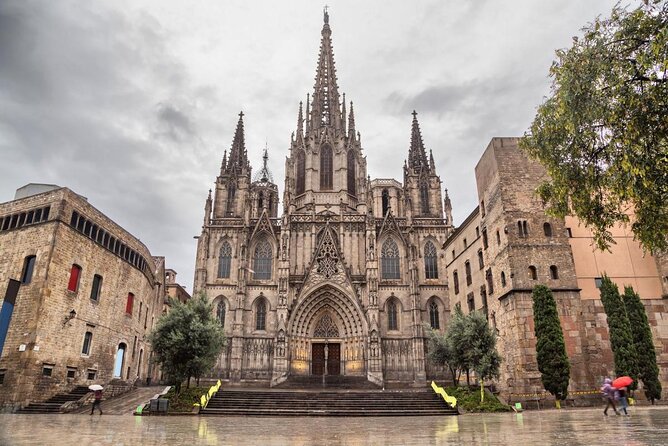
Stop 3: Catedral de Barcelona and Saint Eulalia’s martyr story
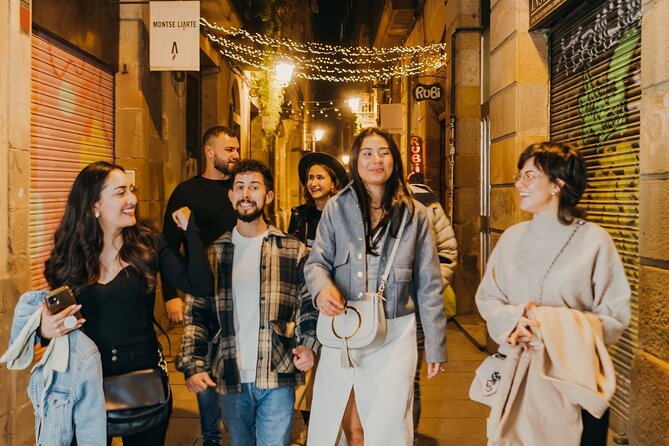
The Cathedral stop is where the tour turns more solemn and dramatic. The Catedral de Barcelona is Gothic in style, and it was built over centuries. The guide focuses on Eulalia, Barcelona’s patron saint, telling the story of her life and death—specifically how her martyrdom is represented in the cathedral’s tradition.
Why it’s worth your attention: you’re not just hearing about a building style. You’re learning how Barcelona frames morality, suffering, and local identity through religious storytelling. That’s why the cathedral is such a big anchor for the city center.
Admission is not included for this stop. So if you’re planning your day tightly, remember that you may need to budget for the cathedral entry fee separately. You’ll have about 10 minutes, which is short—so the guide’s context helps you get more out of less time inside.



Stop 4: Casa de l’Ardiaca and the Roman water remnants
Casa de l’Ardiaca is the kind of stop that makes you slow down without even realizing it. It’s described as a small architectural highlight in the Gothic Quarter, mixing Gothic and Renaissance elements. Even better for history nerds (and normal travelers alike), the guide points out Roman remnants: wall traces and arcade structures related to an aqueduct that supplied water to Barcino.
This stop is valuable because it changes your mental map. Barcelona’s layers aren’t separate eras in a textbook. They overlap. You’re seeing how older infrastructure kept showing up in later design choices.
Admission here is free, and the time is about 10 minutes—just enough to spot the design mix and understand what you’re looking at.
Stop 5: Pont del Bisbe and the superstition moment
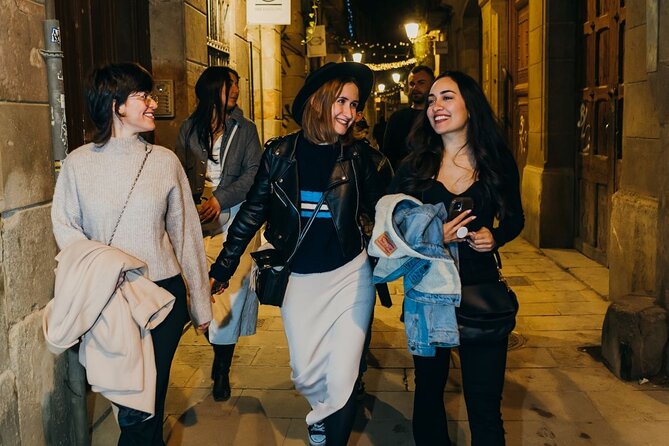
Pont del Bisbe (Bishop’s Bridge) is rumored to be one of the most photographed spots in Barcelona. The guide adds the legend side: there’s a story that can make superstitious visitors think twice before walking underneath it.
Is it something you need to believe? No. But it’s a fun example of how legends attach themselves to physical places in the old city. You’ll probably notice that people take pictures from very specific angles here—partly because it’s scenic, partly because it’s become a symbol.
Admission is free, and you’re in and out in about 10 minutes.
Stop 6: Placa Sant Felip Neri and a scarred political past
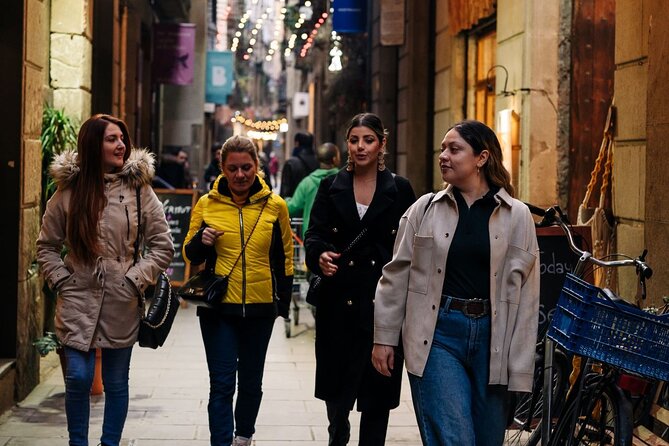
This square is quieter than you might expect from the central streets. The guide frames it as a more somber place, connected to Catalan independence and the tragic history that left marks behind. Even if you don’t know the names of events yet, the stop helps you understand that the city’s identity debates are not distant history—they’re part of how people interpret certain corners of the old center.
Admission is free, and the 10-minute timing keeps it focused rather than overwhelming.
Stop 7: MUHBA – El Call and medieval street memory
MUHBA – El Call brings you into the medieval district connected to Barcelona’s former Jewish population. Narrow streets and older structures create the right feeling: you can sense how life worked in smaller, tighter urban spaces.
This stop matters because it moves beyond the big architectural icons and shows community history tied to street form. The guide’s job here is to help you read the area like a living layout, not just a backdrop for walking.
Admission is free, and time is about 10 minutes—enough for a strong sense of place.
Stop 8: Plaça de Sant Jaume and the government-culture contrast
Plaça de Sant Jaume is the main square of the city core. It houses the seat of Catalan government and the City Hall, so it’s a place associated with both celebration and protest. The guide ties it to an important figure and a holiday many locals mark, but the key value here is the contrast: civic power isn’t just administrative. It’s emotional and public.
If you’re looking for one moment that explains why modern Catalan identity has political muscle, this is often it. You’ll also start seeing how squares work in Barcelona: they’re stages for collective feeling.
Admission is listed as free.
Stop 9: Plaça del Rei and the shadow of the Spanish Inquisition
Plaça del Rei is tied to power and palace history. The Royal Palace is part of the story, and the guide doesn’t shy away from the darker chapter connected to the Spanish Inquisition.
This stop can hit harder if you let it. The square is visually imposing, and the guide adds context so it doesn’t feel like an abstract lecture. You’re connecting the weight of past authority to a physical space that still dominates sightlines.
Admission is free, with about 10 minutes to take it in.
Stop 10: Plaça de l’Àngel and the miracle renaming
Plaça de l’Àngel used to be called Wheat Square, tied to grain trading. The guide explains how it later got renamed when an angelic apparition appeared during the procession of Saint Eulalia’s body.
That naming story does two useful things. It shows how everyday commerce shaped city life, and it shows how religious events could literally rewrite place names. After you hear this, the square feels less like a stop along the route and more like a clue to how the city remembers.
Admission is free, again about 10 minutes.
Final stop: Basilica de Santa Maria del Mar and Barcelona by sea
The walk ends at Basilica de Santa Maria del Mar in El Born. It’s Gothic, but the guide’s emphasis is on why it matters: it’s a testament to Barcelona’s maritime history.
This is a strong ending choice. After walking through religion, politics, and local identity, you finish with the city’s working soul—trade and the sea. The surroundings in El Born also help; you’re in an area that still feels connected to movement and daily life rather than pure museum calm.
Admission is not included for this stop. If you want to see inside, plan for that extra cost.
What you should expect from your English-speaking guide
The best parts of this tour aren’t the buildings. It’s the way the guide tells the stories so they stick. Many guides on this format are known for clarity and energy, and you may hear names like Darren, Petra, Jorge, Sonia, Sonja, Lydia, Sarah, Vanessa, Rolene, or Mariah leading groups in English.
Here’s what that tends to mean for you:
- You get explanations that connect one stop to the next.
- You’re encouraged to ask questions rather than just follow silently.
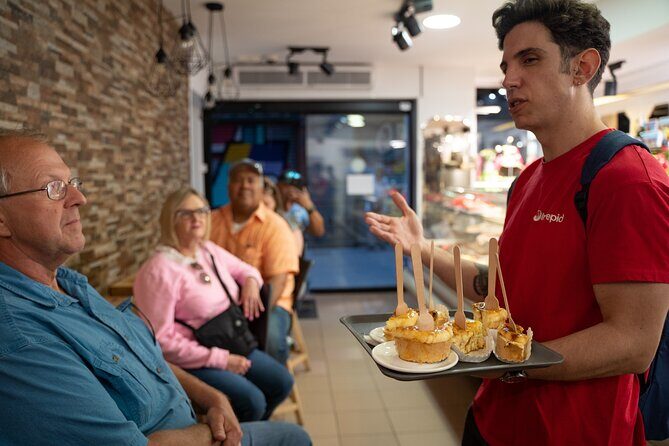
- You may receive practical suggestions beyond the walk, like a tapas recommendation (one example given is Tapas 2254).
One caution from real-world experience: if street noise is high, and there’s no speaker/audioguide, it can be harder to catch every detail. If that matters to you, position yourself where you can hear clearly and don’t be afraid to ask the guide to repeat a key point.
Also, pack for walking. A simple tip like good shoes and sunblock came up for a reason in the feedback. Old streets look flat until your feet remind you they’re not.
Price: how $22.99 can actually be good value
At $22.99 per person for about two hours, you’re in the bargain zone for a guided introduction to Barcelona’s old core. The value comes from three areas:
First, the route density. You cover a lot of high-impact stops in a short time—Els 4 Gats, key squares, Jewish quarter context, and multiple layers of Catalan identity themes.
Second, many stops are free admission. Several of the stops list admission ticket free, so a big chunk of what you pay for is the guide’s interpretation, not entry fees. You’ll only likely need to think about separate admission for the Catedral de Barcelona and Basilica de Santa Maria del Mar.
Third, it’s a small-group format (max 20). That’s not guaranteed quiet, but it does make it easier to actually hear and engage compared to larger crowds.
If you’re visiting Barcelona and want a route you can repeat later on your own, this is one of those spends that can save you money downstream—because you’ll know what’s worth your time to revisit.
Who this 2-hour walk is best for
This tour is a strong fit if you:
- Want Catalan history and culture explained in plain language.
- Prefer a guided route through the Gothic Quarter and El Born instead of hunting for context alone.
- Have limited time and want a first-day orientation that you can build on.
It’s also a good choice if you like art and architecture, but especially if you want the human stories behind them. Els 4 Gats and Picasso/Gaudí connections are here. Saint Eulalia and the naming myths are here. Political memory in squares is here.
If you hate walking or want long museum-style visits, you might find the 10-minute stop rhythm too fast. But for most people, it’s exactly the right tempo.
Should you book Barcelona in 2 Hours?
Yes, if your goal is to get your bearings fast and understand why Barcelona’s old center feels the way it does. The big wins are the story-led approach, the smart pacing, and the mix of art, politics, religion, and community history in a route that ends near Santa Maria del Mar.
Book it sooner rather than later if your dates are fixed, since it’s typically reserved about 42 days in advance on average. And if you’re planning to enter the cathedral and Santa Maria del Mar, budget separately for those admissions since they’re not included.
If you want a guided walk that helps you see beyond postcards, this one is worth your time and money.
FAQ
How long is the Barcelona in 2 Hours guided walk?
It’s about 2 hours.
Where does the tour start and where does it end?
It starts at Plaça del Vuit de Març, Ciutat Vella, and ends at Basílica de Santa Maria del Mar, Plaça de Santa Maria.
Is the tour in English?
Yes, it’s offered in English.
Are entrance tickets included for the cathedral and Santa Maria del Mar?
No. The Catedral de Barcelona and Basilica de Santa Maria del Mar list admission as not included.
How many people are in the group?
The tour has a maximum of 20 travelers.
Is there free cancellation?
Yes. You can cancel up to 24 hours in advance for a full refund.