REVIEW · BARCELONA
Private discovery bike tour of Barcelona
Book on Viator →Operated by Visites Guidées de Barcelone · Bookable on Viator
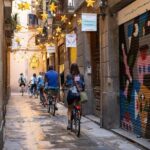
Three hours, one big Barcelona story. This private discovery bike tour strings together the Gothic center, Modernisme blocks, and the sea on mostly easy cycling routes, and your guide can adjust things a bit as you go. I really like that the ride is paced so you get a strong hit of sights without feeling wrecked for the rest of your day.
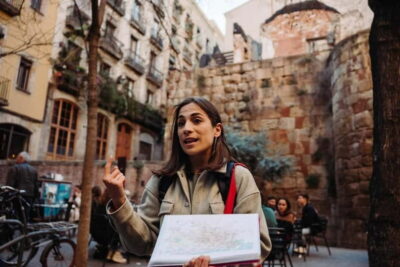
The other thing I appreciate is the way Jean-Pierre brings the stops to life with clear, story-driven explanations (and he’ll show you extra context using maps and his own guide materials). One consideration: his voice can be a little soft at times, especially near traffic or crowd noise, so stay close if you want the details.
In This Review
- Key highlights you’ll care about
- Why this private bike route works in a limited time window
- Plaça Reial and Plaça de Sant Jaume: old Barcelona’s stage set
- The Gothic Cathedral stop: Santa Creu, Santa Eulàlia, and Roman leftovers
- Palau de la Música Catalana and the Modernisme sprint on Passeig de Gràcia
- Sagrada Família: see why the city is still waiting
- Arco di Triomfo, Ciutadella Park, and the coast walk-off
- Bikes, pace, and safety: why your body won’t hate you
- Price and value: getting a lot of famous stops for $48.37
- Who should book this bike tour (and who might not)
- Should you book this private discovery bike tour of Barcelona?
- FAQ
- How long is the private discovery bike tour of Barcelona?
- Is this tour private?
- What language is the tour offered in?
- Where do we meet, and does the tour end back there?
- Do we get tickets included for Sagrada Família, La Pedrera, Palau de la Música, or the Cathedral?
- Are any stops free in terms of admission?
- Is it suitable for most travelers?
- Is the tour dependent on weather?
- What is the cancellation policy?
Key highlights you’ll care about
- Private group with a guide who can flex: you’re not stuck in a rigid, one-size-fits-all script
- Low-energy cycling with plenty of bike lanes: reviews highlight that it feels doable for many people
- A clean route through the Gothic Quarter and Modernisme core: you see the big-name architecture in logical order
- UNESCO modernism stop at Palau de la Música Catalana: you’ll understand why this building matters
- Gaudí’s Barcelona in a short window: from the Mansana de la Discordia to La Pedrera and Sagrada Família
- Sea and ports included near the end: you finish with coastal walking time instead of only streets
Why this private bike route works in a limited time window
Barcelona is huge, and even if you love walking, you can burn hours just moving between neighborhoods. This tour is built to solve that problem. In about 3 hours, you cover a “greatest hits” loop that starts in the old center and finishes near the water, so you’re not constantly crisscrossing the map.
Because it’s private, you get a more human feel than the standard big-group tours. You’re guided step-by-step, and the guide can tweak the plan based on what you want to see most. Reviews mention small custom changes, including a detour to show the beach when requested.
For value, the big win is that you get context at each stop, not just a photo-and-go line-up. You’re also on a bike, so your energy stays in your body and your attention stays on what’s around you. If you want a first-day reset that helps you understand where everything is, this fits well.
You can also read our reviews of more cycling tours in Barcelona

Plaça Reial and Plaça de Sant Jaume: old Barcelona’s stage set

Your ride starts at Plaça Reial in Ciutat Vella. This is one of those plazas that feels cinematic the moment you arrive, anchored by the famous fountain and framed by details attributed to Antoni Gaudí’s world. Even if you don’t go deep inside anything, it’s a strong opening because it teaches you what Barcelona’s “grand square” vibe looks like.
From there you head to Plaça de Sant Jaume, where government power and historic charm sit side by side. This is the place to orient yourself politically and architecturally: you’ll see the buildings associated with Barcelona’s city leadership and Catalan governance.
What I like about this opening stretch is that it’s not random. It sets you up to understand why the city’s architecture and public spaces feel tied together. You’ll also get used to the rhythm of the route early, before you move into tighter streets and major landmarks.
Practical note: these early stops can still be busy at street level, so keep an eye on where you park yourself near the curb while you listen.
The Gothic Cathedral stop: Santa Creu, Santa Eulàlia, and Roman leftovers
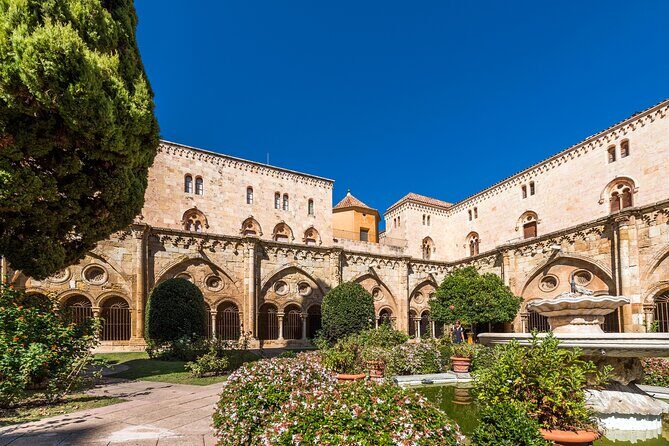
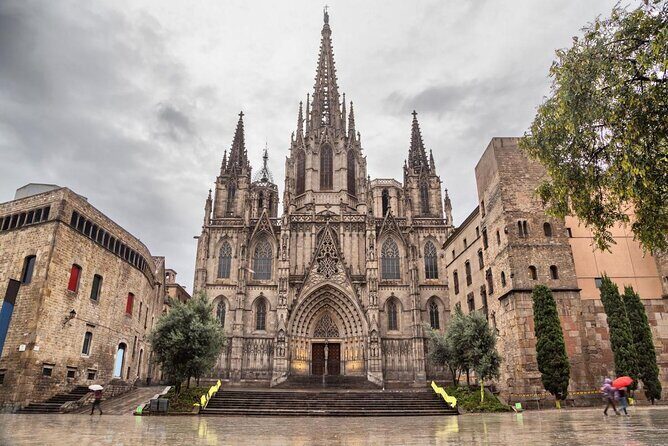
Next comes the Catedral de Barcelona, officially tied to Santa Creu i Santa Eulàlia. The exterior and the cathedral’s approach set the tone for the Gothic side of Barcelona: you get a mix of gothic and neo-gothic feel, and it reads like a layered timeline rather than one single style.
One detail you’ll appreciate here is the mention of Roman wall remains visible on the parvis. That’s the kind of clue that makes the center of Barcelona feel “built over time,” not just built once. It also gives you a mental hook for later stops—Modernisme doesn’t appear from nowhere; the city keeps changing.
Important for expectations: the cathedral’s admission is listed as not included, so plan on what you can see around the site rather than assuming full entry during the tour window. If you want interior time, you’ll likely need to add it separately on your own schedule.
This stop is short (about 10 minutes), so it’s best for spotting what matters and letting the guide put the pieces together quickly.
Palau de la Música Catalana and the Modernisme sprint on Passeig de Gràcia
Then you hit one of Barcelona’s signature moves: modernism packaged as architecture you can read while riding past it. The tour includes Palace of Catalan Music (Palau de la Música Catalana), designed by Lluís Domènech i Montaner and recognized by UNESCO since 1997. Even with limited time, the guide framing helps you see why people treat this building like a headline of Catalan modernism.
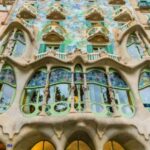
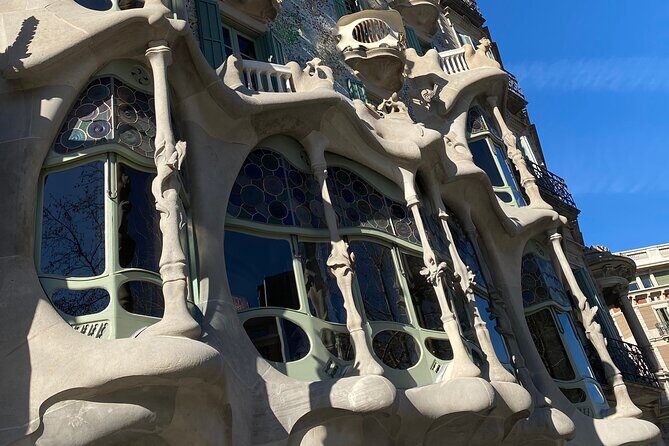
From there you roll into the Mansana de la Discordia area on Passeig de Gràcia. The idea here is simple and fun: three major facades from different modernist architects sit close enough that you can compare styles like an outdoor exhibit. You’ll look at:
- Casa Batlló (Antoni Gaudí)
- Casa Ametller (Josep Puig i Cadafalch)
- Casa Lleó i Morera (Lluís Domènech i Montaner)
This is a standout stretch because the tour gives you the “why” behind the look—so you’re not just seeing sculpted balconies, you’re learning what each architect was trying to communicate.
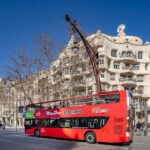
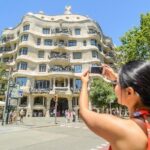
La Pedrera, also called Casa Mila by Antoni Gaudí, is the next stop. It’s one of his later and most imposing works, and it fits the route perfectly because it bridges the “famous facades” stage into the “Gaudí’s full personality” stage. Admission is not included, so again: expect views and explanations more than a long interior visit during the tour.
My advice: if you’re the type who likes to slow down, take one minute to really study a facade before you move on. With a bike tour, you can’t linger forever—but you can still catch one or two details that will stick with you later.
Sagrada Família: see why the city is still waiting
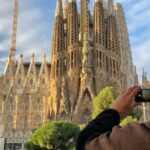
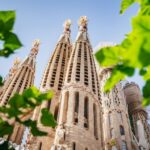
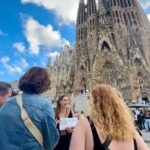
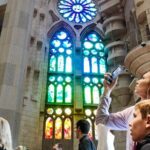
Your big emotional stop is the Basilica de la Sagrada Familia. This is described as the most important Gaudí work and an ongoing project, still incomplete to this day. That detail matters, because it changes how you look at it: you’re seeing a building that’s both sacred and under construction, like Barcelona’s imagination continues working in real time.
The tour window here is about 20 minutes, so you’re not getting a full “tour inside the monument” experience. Admission is not included, meaning you’ll likely focus on the outside views and the guide’s key context points rather than an interior walk-through.
What makes this stop valuable on a bike tour is timing. You reach Sagrada Família after you’ve already learned the Modernisme and Gaudí patterns. That makes it easier to recognize what’s part of the system—shapes, symbolism, and the way Gaudí’s style reads from different angles.
If you want extra time at Sagrada Família after the ride, keep it in mind for your later day plans. This tour gives you the why; you can return for the deeper do.
You can also read our reviews of more private tours in Barcelona


Arco di Triomfo, Ciutadella Park, and the coast walk-off
After Passeig de Gràcia, the route shifts gears. You go to Arco di Triomfo, tied to the first Universal Exhibition held in Barcelona’s Parc de la Ciutadella area. It’s a quick stop, but it helps you connect the city’s monumental core to a specific historical “moment,” not just general vibes.
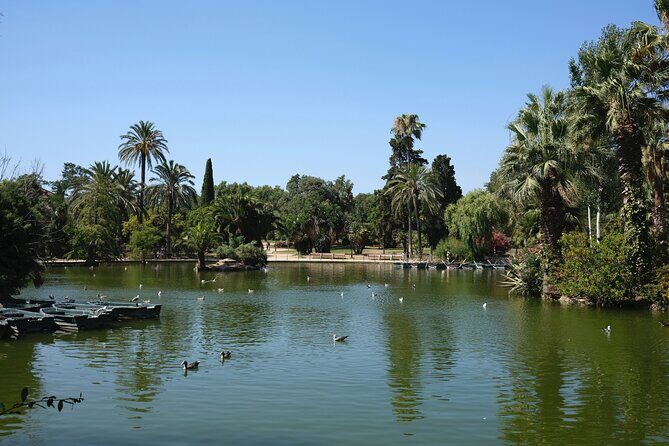
Then comes Parc de la Ciutadella, a former citadel site reshaped into a park in the late 1800s. This is where Barcelona breathes. You’ll see a mix of preserved citadel buildings and park features, including:
- a greenhouse
- an ombrère structure (shade area)
- museums like natural sciences and geology
- a zoo
- and a very notable fountain
Some of this is view-only in a short stop, but it still changes the feel of the tour. You’re not only looking at architecture; you’re seeing how the city repurposed a harsh past into public space.
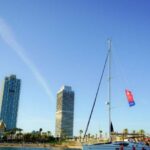
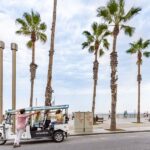
Finally, you roll into the harbor zone with Port Olimpic and then head along the coast to Platja de Sant Sebastià for a promenade feel. After that you move to Port Vell (Old Port) for a finishing walk along the old harbor.
This coastal sequence is smart because it gives your legs a change of pace. You’re biking to the waterfront, then walking a bit so you can take in the sea air and the port energy.
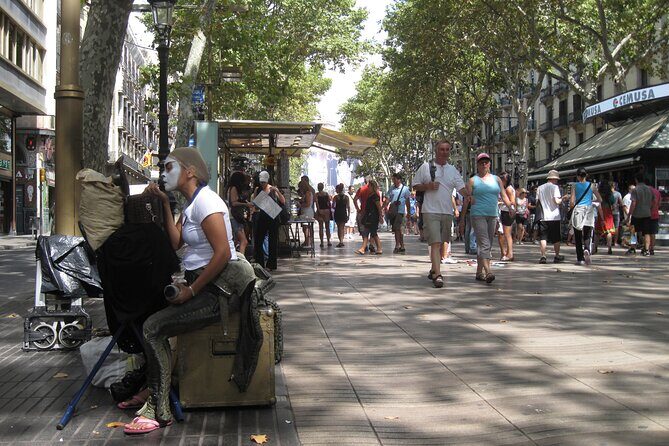
Expect some pedestrian traffic in this final stretch. A few reviews note it can take a moment to get used to crowded areas while cycling through them, so your calm focus matters.
Bikes, pace, and safety: why your body won’t hate you
Barcelona has bike lanes, and this route uses them in a way that keeps effort low. Reviews specifically mention easy, comfortable bikes and a pace that doesn’t leave you tired for the rest of the day. That’s not a small deal. If you’re on vacation with packed plans, you want “movement with value,” not a workout that costs you your evening.
Safety-wise, the guide leads you through the route, and you follow their cues. Many reviews highlight that Jean-Pierre made riders feel safe. Still, you should know that parts of the route include shared streets or busy pedestrian zones. If you’re anxious about tight spaces, keep your attention on the guide and your own line.
The tour is also described as suitable for most travelers. That usually means the bike part is manageable, but you still need basic comfort on two wheels. If you’ve never biked in a city, I’d treat this as a gentle first step, not an extreme challenge.
One small drawback to keep in mind: the guide can be soft spoken at times. Bring your “listen-mode” close to stops, especially where traffic noise rises.
Price and value: getting a lot of famous stops for $48.37
At $48.37 per person for about 3 hours, the price is mostly about what you’re buying: guided routing plus explanations across many high-demand sights.
A key value point is that you’re seeing a lot of major landmarks in one loop:
- Gothic center landmarks
- Modernisme highlights around Passeig de Gràcia
- Gaudí’s major works
- Ciutadella Park
- ports and beaches
Not everything includes admission. Several major buildings—like the cathedral, Palau de la Música Catalana, La Pedrera (Casa Mila), and Sagrada Família—are listed as not included for entry. That means you’re paying for guidance and outside/site-time, not a full ticket bundle.
So ask yourself this: do you want to spend your time learning and moving between places, and then return later for deeper interior visits? If yes, this price makes sense. If you want all “inside the building” time during those 3 hours, you may feel the missing admission time.
Where the money feels most justified is the combination of efficiency and explanation. You’re not just collecting stamps; you’re building a mental map so your later self-guided wandering makes more sense.
Who should book this bike tour (and who might not)
This tour is a great fit if:
- it’s your first trip to Barcelona and you want context fast
- you like architecture and want it explained in plain terms while you ride
- you want a more comfortable pace than a full-day walking plan
- you’re traveling with kids or older teens who can handle a bike tour and enjoy seeing famous buildings without waiting in long lines for hours
It’s also a good fit if you want a private guide who can make small changes. Reviews mention flexibility for minor customizations, including a beach detour when asked.
You might consider another option if:
- you strongly prefer long interior museum time (this tour focuses on short stops and views at several sites)
- you’re very sensitive to audio in noisy areas (the guide’s voice can be hard to catch sometimes)
Should you book this private discovery bike tour of Barcelona?
If you want a smart first look at Barcelona that mixes Gothic, Gaudí, UNESCO modernism, and the coast, I’d book it. The ride covers huge ground in a short window, and the guide-led explanations turn “photo stops” into a story you’ll remember.
I’d also book it if you value comfort: the cycling is set up to feel manageable, and the pace is designed so you’re not done for the day after three hours. The private format is another plus, especially if you want flexibility.
If you’re the type who plans full interior visits at multiple monuments, treat this as your orientation ride and then plan separate time slots for the big-ticket interiors later.
Bottom line: for a 3-hour introduction that connects Barcelona’s most famous architecture with its sea-and-park side, this is an excellent use of time.
FAQ
How long is the private discovery bike tour of Barcelona?
It’s about 3 hours (approx.).
Is this tour private?
Yes. It’s a private tour/activity, so only your group participates.
What language is the tour offered in?
The tour is offered in English.
Where do we meet, and does the tour end back there?
You start at Plaça Reial (Pl. Reial, Ciutat Vella, 08002 Barcelona, Spain) and the activity ends back at the meeting point.
Do we get tickets included for Sagrada Família, La Pedrera, Palau de la Música, or the Cathedral?
No. For Sagrada Família, La Pedrera (Casa Mila), Palace of Catalan Music, and the Catedral de Barcelona, admission is listed as Not Included.
Are any stops free in terms of admission?
Yes. Several stops are listed as Free Admission, including Plaça Reial, Plaça de Sant Jaume, La Mansana de la Discordia, Arco di Trionfo, Parc de la Ciutadella, Port Olimpic, Platja de Sant Sebastia, and Port Vell.
Is it suitable for most travelers?
The tour notes that most travelers can participate.
Is the tour dependent on weather?
Yes. The experience requires good weather. If canceled due to poor weather, you’ll be offered a different date or a full refund.
What is the cancellation policy?
You can cancel for a full refund up to 24 hours in advance of the experience’s start time.