REVIEW · BARCELONA
Barcelona: “The Secret of Cerdà” Treasure Hunt Walking Tour
Book on GetYourGuide →Operated by Mystery City · Bookable on GetYourGuide
Barcelona hides its best secrets in plain sight.
This Barcelona treasure hunt walking tour turns the city center into an outdoor escape-room style game: you pick up a backpack of tools, follow a map, solve challenges, and end by opening a locked treasure box tied to Cerdà’s story about Barcelona. I especially love how the clues force you to notice details you’d otherwise rush past, and how the route strings together major neighborhoods with enough breaks to take your time and enjoy the walk.
There is one catch: you’re moving at puzzle pace, not sightseeing-rapid-fire pace. If you want a straight checklist of highlights with minimal stopping, this may feel slow, and a few people find it can take a bit longer than the headline time.
In This Review
- Key things to know before you go
- A Cerdà-themed walk-game that makes you look twice
- Start at Carrer de Trafalgar 17 and get your “tools”
- How the mystery works: map clues, story stops, and working locks
- Stop-by-stop: Illa de la Discòrdia, built for puzzle momentum
- Gothic Quarter: where the challenges make the maze feel purposeful
- Eixample District: puzzles guide your pace through a different feel
- Plaça de Catalunya: your puzzle pivot point and rest break
- Palace of Catalan Music area: learning stories while you stay on task
- The final Barcelona segment: solving the full mystery and ending back at the start
- Time and pace: 2.5 hours is the target, not the guarantee
- Price and value: why $26 can feel like a bargain in the right group
- Who this walking treasure hunt suits best
- Practical tips that make the experience smoother
- Should you book this Barcelona treasure hunt?
- FAQ
- Where does the tour start?
- How long is the experience?
- Is this a private experience?
- What ages is it suitable for?
- What languages are available?
- Is it wheelchair accessible?
- Is it okay to play alone?
Key things to know before you go
- Private by booking: you play with your own group, even if other groups start nearby
- Treasure-map route through the center: five top stops plus extra walking time to soak it in
- Challenge-based story stops: you get Barcelona history context and solve something at each location
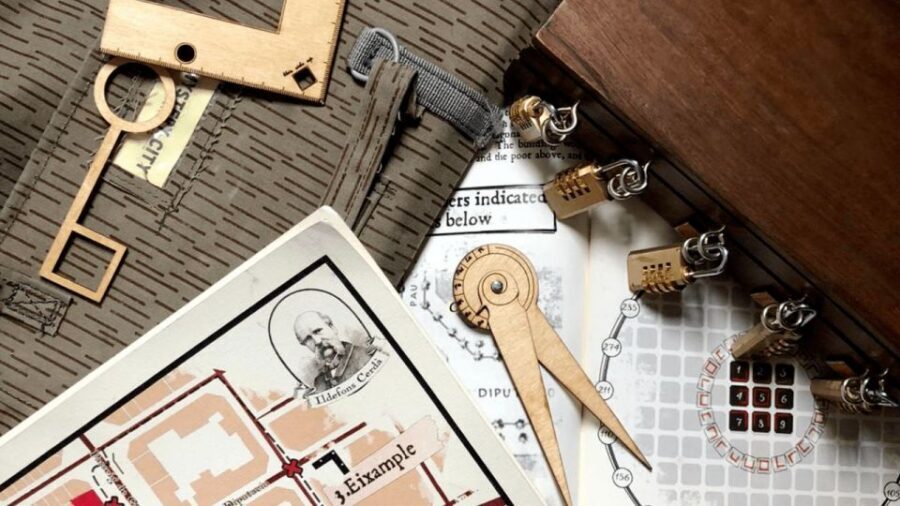
- A locked treasure box at the end: open all the locks to solve the mystery and claim your prize
- QR code help for tricky moments: built-in support shows up when a step gets hard
- Designed for adults, works with teens: suitable for kids 7+ with parents (not for children under 6)
A Cerdà-themed walk-game that makes you look twice
If you like Barcelona but also like games, this is a smart way to spend a chunk of your day. Instead of just staring at façades and reading signs, you’re hunting for clues that get you to slow down, check details, and follow a story thread through the city.
What I like most is the structure. You always know what you’re doing next: find the next stop, read the context, solve the challenge, and use the result to work the locks back at the treasure box. It’s playful, but it still functions like a tour, because the route is built around real places people commonly visit.
You can also read our reviews of more walking tours in Barcelona



Start at Carrer de Trafalgar 17 and get your “tools”
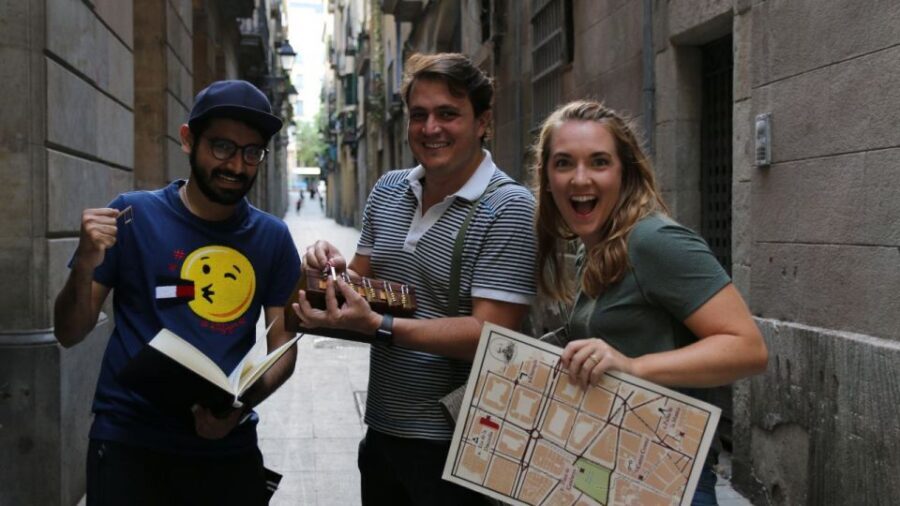
Your adventure begins at Carrer de Trafalgar, 17, near Plaça Urquinaona. You’ll pick up a backpack filled with the game materials: a treasure map, a treasure box, an book of challenges, and other “magical tools” used throughout the puzzles.
This matters more than you might think. When a hunt like this starts with everything organized, you avoid the usual chaos of standing around, asking questions, and losing the thread. Once you’re holding the map and the right materials are in your hands, the experience feels smooth.
Languages are also a practical plus. The host/greeter can support you in English, Spanish, Catalan, and French, so you’re not stuck guessing your way through the mission.
How the mystery works: map clues, story stops, and working locks
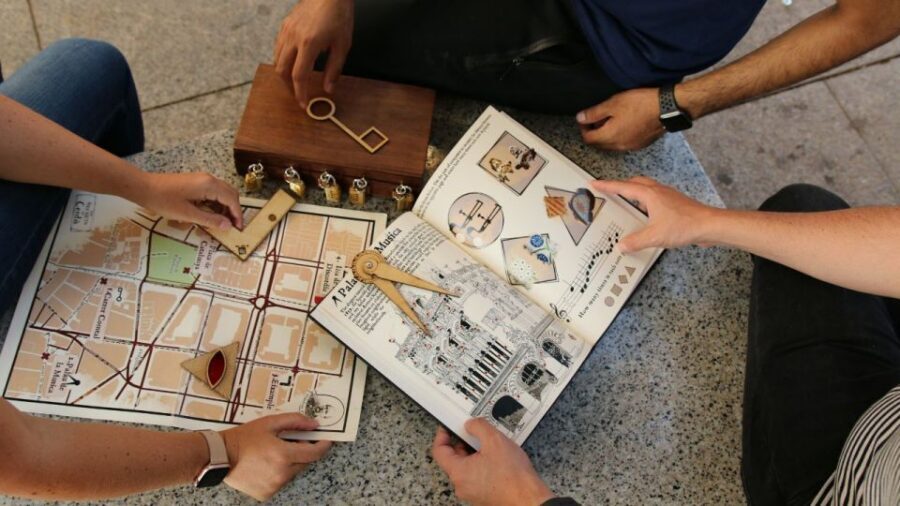
The game takes about 2 hours, but you’ll often want extra time. The host encourages you to take your time while you walk, shop along the way, and take photos.
At each of the main locations, you’ll get:
- A story about Barcelona’s history
- A challenge designed to make you notice secret details or hidden spots
- The next piece needed to open a lock on your treasure box
Then you return to the start point at the end to claim your prize once you’ve solved the full mystery.
One useful detail from real participants: when a puzzle step is tricky, there’s help available via a QR code. That’s the difference between getting stuck for 30 minutes versus keeping momentum.
Stop-by-stop: Illa de la Discòrdia, built for puzzle momentum
Your first sightseeing stop is Illa de la Discòrdia (about 20 minutes on the schedule). In a game like this, the first location has two jobs. One is to get you oriented with the rules. The other is to set the tone: make you feel like the city is answering back when you look closely.
You’ll be doing short work, then moving on. That keeps energy up. It also means you’re less likely to “burn out” mentally on clues before the fun part kicks in.
Potential drawback: if you’re the type who hates any “pause” during sightseeing, a 20-minute puzzle stop might feel like a lot at the beginning. The trade-off is that your later locations feel more rewarding, because you’ve already learned how to think like the game wants.
Gothic Quarter: where the challenges make the maze feel purposeful
Next up is the Gothic Quarter (again, around 20 minutes). This is a neighborhood that naturally rewards slow wandering. In this tour, your wandering has a goal: you’re not just moving through old streets, you’re hunting for clues that help you solve locks later.
Because the format includes challenges at each location, you’ll likely spend more time looking at your surroundings than you would on a normal walk. And when a puzzle nudges you to focus, you often start noticing small details faster than you expect.
A practical consideration: parts of the Gothic Quarter route can feel more like “walk-and-scan” than “stand-and-view.” If you prefer calm photo stops over movement, plan on doing a few quick snapshots rather than lingering for long stretches in one spot.






Eixample District: puzzles guide your pace through a different feel
Then comes the Eixample District (about 20 minutes). Even without needing to be an architecture expert, this stop works because it changes your rhythm. The game keeps you moving, but it also gives you a structured moment to stop, read, and solve.
I like this part because it balances the experience. You get the feel of different Barcelona neighborhoods, and the puzzle format makes the transitions less abrupt. Instead of walking “from one sight to the next,” you’re walking “from one clue to the next,” which feels more satisfying.
If you’re traveling with teens or active adults, this is where many groups hit their stride. People often find the puzzles challenging enough to feel earned, not impossible, especially with QR code help when you’re stuck.
Plaça de Catalunya: your puzzle pivot point and rest break
After Eixample, you head to Plaça de Catalunya (about 20 minutes). This is a helpful location in the context of a walking game because it’s a natural meeting point for busy city life. The hunt format also makes it less stressful: you don’t have to invent what to do next, because the map and the mission drive your timing.
Plan for this stop to feel like a reset. Take a quick breather, check your progress, and make sure you understand what the challenge is asking. The game is designed to make you solve something at each location, so if you rush through without reading, you might lose time later when you realize you missed a clue.
Palace of Catalan Music area: learning stories while you stay on task
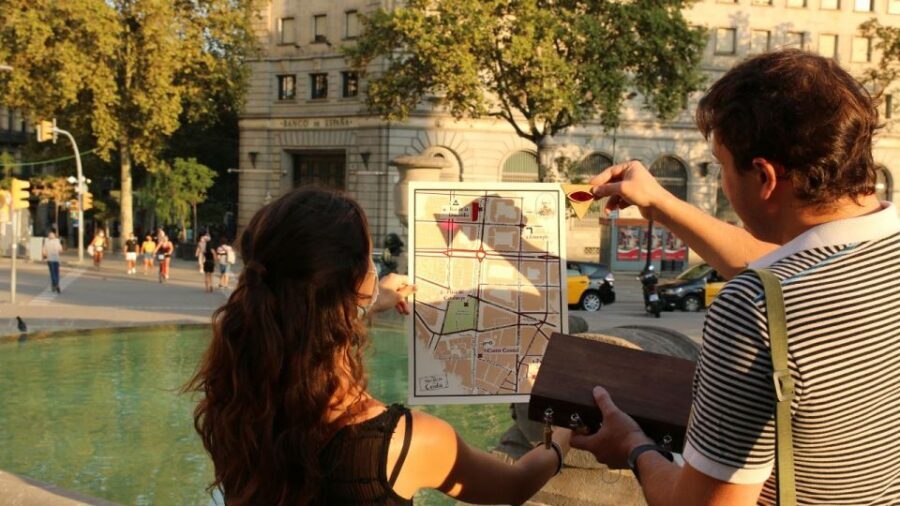
The next major stop is the Palace of Catalan Music area (about 20 minutes). This part is about blending two things: a meaningful setting and puzzle work. The game doesn’t just drop you in front of a landmark. It ties the location to a story and then asks you to do something with that information.
That combo tends to work better than “see it, done.” When a tour includes a short story plus a challenge, you remember the place longer because you mentally connected it to an action.
A small watch-out: if you’re traveling during peak hours, this is the kind of area where walking may slow down. Because the tour encourages you to take your time anyway, that slowdown may not ruin your experience, but it can stretch the schedule if your group is strict about getting somewhere else after.
The final Barcelona segment: solving the full mystery and ending back at the start
The itinerary also includes a final sightseeing segment simply labeled Barcelona (about 20 minutes). Think of this as your wrap-up window, when the mission’s momentum should be high. This is where you typically connect the last puzzle results, open remaining locks, and get ready to finish strong.
Once you’ve opened all the locks, you return to the starting point to claim your prize.
What you should expect mentally: the closer you get to the end, the more you’ll feel the “aha” rhythm. The game is built so you’re not just doing random tasks; each stop advances the mystery.
Time and pace: 2.5 hours is the target, not the guarantee
The total duration is 2.5 hours, with the game itself taking around 2 hours. You’re encouraged to take extra time to explore, shop, and take photos along the way.
A key insight from real-world experience: some groups find it can take a bit longer than expected, even when they don’t stop walking. So if you’re planning dinner right afterward, give yourself a buffer.
If you’re the planner type, do this: treat the 2.5 hours as a minimum, not a deadline. You’ll enjoy it more, and you won’t feel rushed when the puzzles take longer than the first guess.
Price and value: why $26 can feel like a bargain in the right group
At $26 per person, this is priced like an affordable activity—especially for something that mixes city wandering, a puzzle system, and a final payoff with a treasure box.
Here’s what drives value:
- You get a ready-to-go game kit (map, challenge book, tools, treasure box)
- You’re paying for structured time in multiple neighborhoods, not just one stop
- The puzzle format gives you a reason to slow down without turning it into a long classroom-style tour
Is it for everyone? No. If you only want quick monument photos and zero “thinking time,” you may feel like you’re buying an activity you didn’t ask for. But if you like interactive travel, it’s a good use of time.
Who this walking treasure hunt suits best
This game is designed for adults, and it’s also listed as suitable for children 7+ when they play with their parents. It’s not recommended for children under 6.
I’d especially recommend it if:
- you’re traveling with a mixed-age group that likes doing things together
- you want an alternative to a standard guided tour
- you enjoy puzzles and don’t mind stopping briefly in public spaces
It’s also noted that you don’t recommend playing alone. That’s a real factor. Puzzle solving can go faster and feel more fun when you can brainstorm, compare what you see, and split tasks.
Practical tips that make the experience smoother
A few small moves can help the whole experience feel better:
- Bring comfy shoes. The route is short per stop, but the overall walk adds up.
- Stay flexible on timing. The hunt has built-in stops and puzzle moments.
- Use the QR code help if you get stuck. It’s there for tricky parts, and it helps you keep your energy.
- If you’re traveling with kids or teens, set a team rule like: one person reads, one person tries the next step.
These details matter because the best part of the day is the flow. You want to keep moving through the story rather than getting stuck on one lock.
Should you book this Barcelona treasure hunt?
If you want a fun, structured way to explore central Barcelona while staying interactive, I think this is a strong choice. The big win is the combination: real places plus story-based challenges plus a clear ending.
I’d skip it if you hate puzzles, or if you’re chasing a fast, classic sightseeing tour with minimal stops. Also, if your schedule is tight with no buffer for a slightly longer pace, you’ll feel the pressure.
Book it if your idea of a great travel day is: walk, look closely, solve something, laugh a little, and end with a payoff.
FAQ
Where does the tour start?
It starts at Carrer de Trafalgar, 17, near Plaça Urquinaona.
How long is the experience?
The game takes about 2 hours, and the full tour is listed as about 2.5 hours.
Is this a private experience?
Yes. All bookings are private, and you play with your own group. If other groups are also participating, they play separately.
What ages is it suitable for?
It’s designed for adults. It’s suitable for children 7+ when they play with their parents, and it isn’t recommended for children under 6.
What languages are available?
You can get the experience in English, Spanish, Catalan, and French.
Is it wheelchair accessible?
Yes, it’s listed as wheelchair accessible.
Is it okay to play alone?
It’s not recommended to play alone. The game is designed for groups to work through challenges together.