REVIEW · BARCELONA
Barcelona Walking Tour of Gothic and Born District
Book on Viator →Operated by SANDEMANs Tours - Barcelona · Bookable on Viator
Barcelona can feel like a puzzle at first. This tour helps you fit the pieces together with a local guide and a tight walk through the old core. You’ll move at an easy pace for about 2 hours 30 minutes, mostly on foot, with stops designed to explain what you’re seeing and why it matters.
I especially like two things: first, you get a clear sense of the city’s layout as you go, not just a list of monuments. Second, the route ends in a smart spot—either near the El Born Centre area or close to Parc de la Ciutadella—so you can keep exploring right after. The one thing to consider is that the tour can skew toward narration over pure walking, so if you want lots of time to wander off on your own, you may feel a bit boxed in.
In This Review
- Key highlights at a glance
- Starting at Jaume I and Finding Your Bearings Fast
- Placa del Rei: King Martin’s Watchtower and the Columbus Moment
- Barcelona Cathedral: The Big Gothic Showpiece (and the Extra Ticket Factor)
- Church of San Felipe Neri Square: Baroque Calm with Civil War Scars
- Homenatge Als Castellers: Catalan Identity in Human Towers
- Basilica de Santa Maria del Pi: A 15th-Century Gothic Stop Worth Slowing Down For
- Basilica de Santa Maria del Mar: The Sea Cathedral and Why Merchants Built It
- El Fossar de les Moreres: A Memorial That Makes You Stop and Breathe
- Ending Near El Born Centre or Parc de la Ciutadella
- Price and Value: What $4.79 Really Buys You
- Who Should Book This Gothic and Born Walk (and Who Might Not)
- Should You Book It?
- FAQ
- How long is the Barcelona Walking Tour of Gothic and Born District?
- When does the tour start, and where do I meet?
- Where does the tour end?
- Is the tour in English?
- Are tickets included for the cathedral and other churches?
- What’s the price and group size?
Key highlights at a glance
- Columbus-and-the-Monarchs connection at King Martin’s Watchtower in Placa del Rei
- Gothic architecture stops that show different styles in a short time
- Castellers monument explaining Catalan identity through human towers
- War memory at Fossar de les Moreres and a chance to pause and reflect
- A low price point that’s great for first-timers who want orientation fast
Starting at Jaume I and Finding Your Bearings Fast
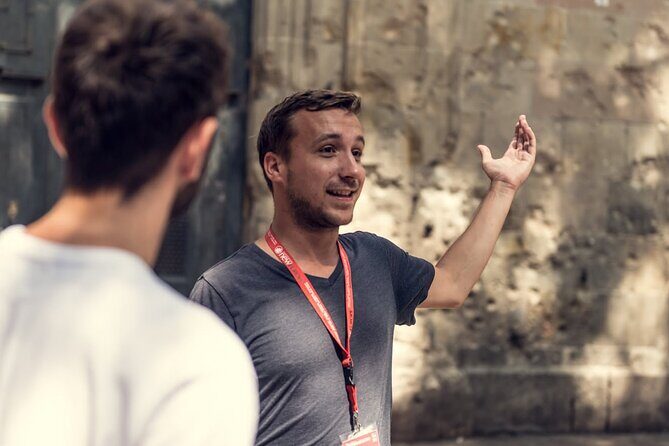
You meet near Jaume I (Ciutat Vella), and you get going at 11:00 am. From the start, the goal is practical: help you understand where you are in Barcelona’s historic center, so you can navigate the maze later without needing to ask every other person for directions. That’s a big deal in Gothic Quarter streets, which can look similar if you’re not paying attention.
This one is also built for small groups. The tour caps at 25 people, which keeps the pace manageable and makes it easier to hear your guide. If you’re traveling solo, that’s a comfort, not a burden—Barcelona is walkable, and having a plan helps you avoid the “where do we go next?” spiral.
You’ll have a local guide for the English-speaking experience, and there’s also a Spanish-speaking guide involved. In practice, that usually means clear commentary and quick questions if you’re paying attention.
You can also read our reviews of more walking tours in Barcelona



Placa del Rei: King Martin’s Watchtower and the Columbus Moment
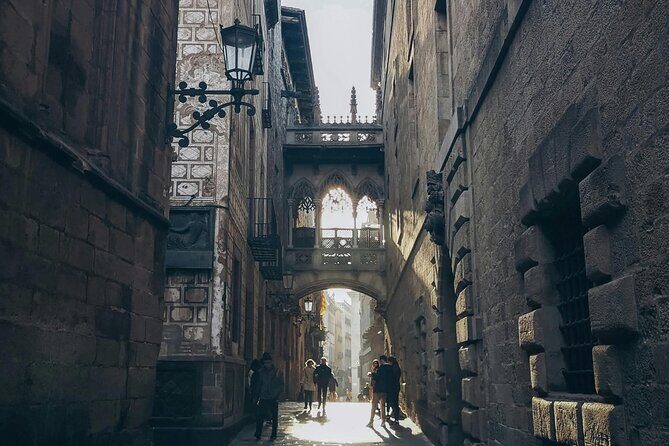
The first stop is Placa del Rei, in the Gothic Quarter. This is where medieval Barcelona starts to feel real, not like postcard wallpaper. The star here is King Martin’s Watchtower, a striking structure tied to one of the most famous episodes of the era: Christopher Columbus was received by the Catholic Monarchs upon his return from the Americas.
Even if you know the broad story of Columbus, the setting changes the feeling. You’re not in a textbook—you’re in the kind of place where court politics, power, and travel all met. It also gives you a useful anchor point for the rest of the walk, because you can start mapping the Gothic Quarter in your head from this location.
Timing-wise, plan on about 30 minutes at this stop. That’s enough to look up at the structure, absorb the medieval vibe, and hear the explanation without rushing you out the door. Admission is free for this part, so you’re not paying to start your tour.
Barcelona Cathedral: The Big Gothic Showpiece (and the Extra Ticket Factor)
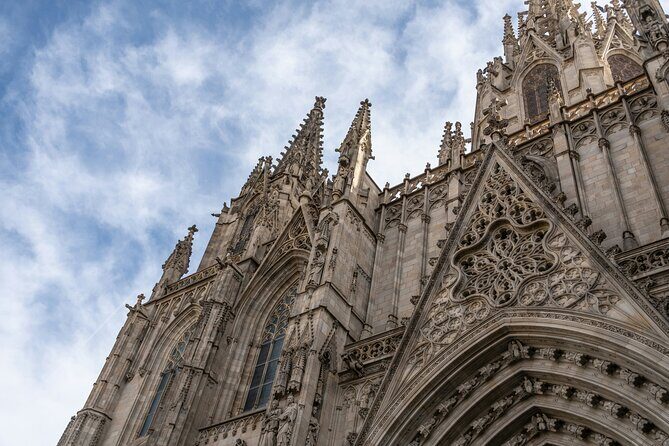
Next you’ll stand in front of Barcelona Cathedral, one of the city’s iconic Gothic landmarks. Expect plenty of time for photos and for your guide to connect what you’re seeing with the people and events tied to the building.
Here’s the key practical detail: cathedral entry isn’t included. The tour time at the cathedral is around 40 minutes, but if you want to go inside (or go deeper), you may need an additional ticket. For most first-time visitors, this is the part where it’s worth deciding your style ahead of time: do you prefer the exterior and explanations, or do you want the full interior experience?
Also, don’t treat the cathedral as a single “look and move on” stop. The value is in the guide’s way of pointing out features and stories, so you get more than a quick glance. If you’re the type who likes architecture details—lines, shapes, and how Gothic design aims for height—this is one of the stronger moments.
Church of San Felipe Neri Square: Baroque Calm with Civil War Scars
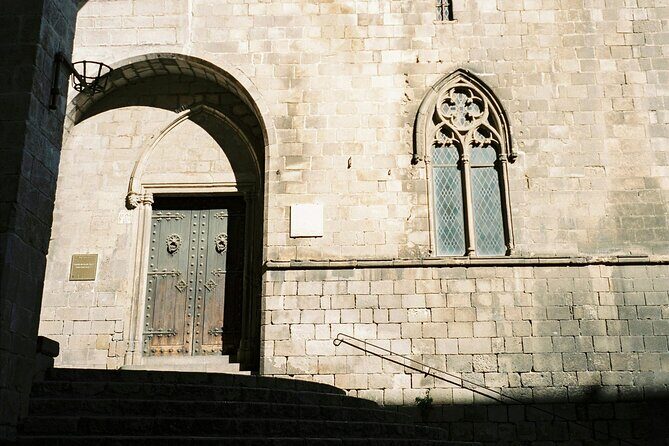
Then it’s over to the Church of San Felipe Neri, where you’ll spend about 20 minutes around San Felipe Neri Square. This stop is quieter, and that balance is helpful. After the scale of the cathedral area, you get a more human-sized plaza where the atmosphere changes fast.
What makes this place memorable is the contrast between past and present. The square is marked by scars from the Spanish Civil War, and it also holds the baroque Church of San Felipe Neri. That combination can be heavy, but it’s also one of those “Barcelona isn’t only about beauty” reminders that makes the city feel honest.
Admission here is free, so you’re not stuck thinking about tickets mid-walk. You’ll likely have enough time to pause, look at the plaza, and let the story land. If you’re traveling with teens or someone who gets bored with “yet another church,” this stop usually works because it’s about real history you can see right in the stonework.
Homenatge Als Castellers: Catalan Identity in Human Towers
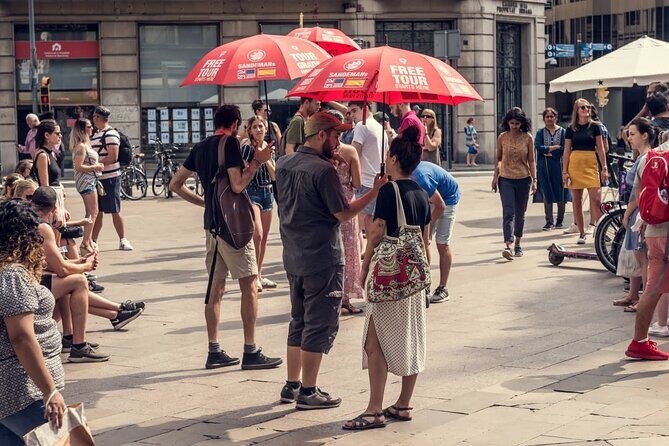
At around 15 minutes, you’ll visit the Monument to the Castellers (Homenatge als Castellers). This is a stop that many people don’t expect to matter—until they understand it. Castellers are famous for human towers built through coordination, risk, and teamwork. Your guide will connect that to Catalan national identity, legends, and heroic figures.
I like this stop because it’s not just architecture or war memorials. It’s culture you can picture immediately. You can almost imagine the crowd, the rhythmic calls, and the way families and communities show up for something that isn’t just entertainment—it’s identity.
And since the monument is essentially outdoors, you don’t need tickets or long lines. Admission is free here, and the tone often feels lighter. It’s a good reset before more major church stops.



Basilica de Santa Maria del Pi: A 15th-Century Gothic Stop Worth Slowing Down For
The route then moves to Basilica de Santa Maria del Pi, with about 15 minutes here. This is a 15th-century Gothic church in the Barri Gòtic district. Even with a short stop, it helps you understand the Gothic Quarter isn’t one single style—it’s a collection of buildings shaped by different eras and communities.
Important detail: admission isn’t included for this stop. So you’ll likely experience it mainly from the outside and through your guide’s explanations. If you’re the type who always wants inside access, this is where you should decide if you want to pay separately at the time you’re there—or save your budget for cathedral-style entries.
What I find valuable about this stop is that it adds variety. You go from cathedral scale, to baroque-in-a-plaza history, to cultural symbols, and then to another Gothic church form. In a short tour, that variety teaches you how the neighborhood’s identity changes block by block.
Basilica de Santa Maria del Mar: The Sea Cathedral and Why Merchants Built It
After that, you head to Basilica de Santa Maria del Mar, also around 15 minutes. This one is often described as having rare purity and unity of style, and it’s linked to the nickname Cathedral of the Sea—because it was built by Barcelona’s medieval merchants and sailors.
Again, admission isn’t included, so you’ll get guided viewing and storytelling rather than a guaranteed interior visit. Still, the value is how the guide frames the building. When you hear that it’s a merchant-and-sailor project, the church stops feeling like distant elite architecture and starts feeling like something tied to everyday work, risk, trade, and teamwork.
If you’re someone who likes to connect buildings to real jobs and real people, this stop lands well. You see a finished Gothic space, but the explanation reminds you it was created by people who dealt with ships, weather, and logistics—not just ceremonies.
El Fossar de les Moreres: A Memorial That Makes You Stop and Breathe
The last stop is El Fossar de les Moreres, with about 15 minutes. This is a solemn memorial honoring the defenders of Barcelona who fell during the Siege of 1714. It’s a place for remembrance, and your guide should give it the respectful tone it deserves.
I like this stop for two reasons. First, it gives emotional context to the city beyond sightseeing. Second, it changes your pace—Barcelona streets can trick you into moving fast and never thinking. Here, you slow down on purpose.
Admission for this memorial is free. You’ll leave with a different sense of what Barcelona has survived, and why certain symbols and public spaces matter. It’s not just a photo stop; it’s a moment to reflect.
Ending Near El Born Centre or Parc de la Ciutadella
The tour finishes in Ciutat Vella, near Passeig de Picasso (1730, Ciutat Vella), with the experience ending by either El Born Centre de Cultura i Memòria (Plaça Comercial, 12) or Parc de la Ciutadella. That ending is practical because it puts you close to more exploring zones without forcing you to backtrack across the densest streets.
If you end near El Born Centre, you’ll be in a good position to continue with museums, cafés, and more walking through the Born area. If you end near Parc de la Ciutadella, you’ll get a chance to decompress—trees, open space, and a calmer mood after the tighter Gothic lanes.
Either ending helps you turn the tour into a full half-day plan. Do the walk, then spend your next hours choosing your own pace—shopping, museum stops, or just finding a spot to eat without navigating the maze from scratch.
Price and Value: What $4.79 Really Buys You
At $4.79 per person, this is one of those deals that can make you suspicious—until you see how it works. The value isn’t in entrance fees, because several stops don’t include admission. The value is in orientation plus context. For a low price, you’re buying a guide who explains what you’re looking at and helps you connect landmarks to stories.
So here’s the budgeting thought you should keep in mind: you might pay extra later if you want to go inside at places like the cathedral, Santa Maria del Pi, or Santa Maria del Mar. The tour is still good value even if you skip interiors, but it’s smart to know that the price doesn’t cover everything on the route.
Also, because it can feel more talk-heavy than walk-heavy, think of this as a guided history-and-city-layout lesson. If you’re okay listening and looking at the same time, $4.79 becomes a bargain. If you prefer silent self-guiding with long photo time, you may feel it’s a bit more structured than you want.
One small caution from the experience style: some people felt a guide discussion after the tour can turn into a request related to extra support. If tipping or additional payment matters to you, decide your comfort level before you go.
Who Should Book This Gothic and Born Walk (and Who Might Not)
This is best for first-time visitors who want to get their bearings quickly. It’s also a solid pick if you’re short on time but still want a guided route through the Gothic Quarter and into the Born area. You’ll come away with a clearer idea of where Barcelona’s landmarks sit relative to each other.
You’ll likely enjoy it most if you like history that has visible footprints—things like the Spanish Civil War scars around San Felipe Neri Square and the memorial context at El Fossar de les Moreres. And if you enjoy culture as much as buildings, the Castellers monument is a nice shift from stone to people.
Who might not love it: if you want a long, mostly unscripted wander with plenty of time to pop into buildings, you may feel the structure doesn’t leave you enough freedom. Also, if you dislike tours that feel narration-heavy, plan to treat this as a guided explanation session rather than a leisurely stroll.
Should You Book It?
I’d book it if your goal is orientation + stories at a very low price. The route hits several of the big Gothic-and-adjacent highlights in about 2.5 hours, and the ending near El Born Centre or Parc de la Ciutadella is a smart bonus.
Skip or reconsider if you’re mainly chasing interior access and want ticketed entry included, because key stops list admission not included. Also, if you hate structured pacing and prefer to wander alone, you might feel it’s more guided talk than free roaming.
If you do book, go in with a simple plan: wear comfy shoes, bring water, and decide ahead of time whether you’ll add tickets for interiors at the cathedral and the major basilicas.
FAQ
How long is the Barcelona Walking Tour of Gothic and Born District?
It’s about 2 hours 30 minutes.
When does the tour start, and where do I meet?
The start time is 11:00 am, and the meeting point is near Jaume I, Ciutat Vella (08002 Barcelona).
Where does the tour end?
It ends near Passeig de Picasso (1730, Ciutat Vella). The finish area is by El Born Centre de Cultura i Memòria or by Parc de la Ciutadella.
Is the tour in English?
Yes, it’s offered in English.
Are tickets included for the cathedral and other churches?
Admission is not included for Barcelona Cathedral, Basilica de Santa Maria del Pi, and Basilica de Santa Maria del Mar. Some other stops on the walk are free.
What’s the price and group size?
The price is $4.79 per person, and the tour has a maximum of 25 travelers.
If you want, tell me your travel dates and whether you plan to enter the cathedral or just view from outside, and I’ll help you map what to do with the rest of your day around El Born and Ciutadella.